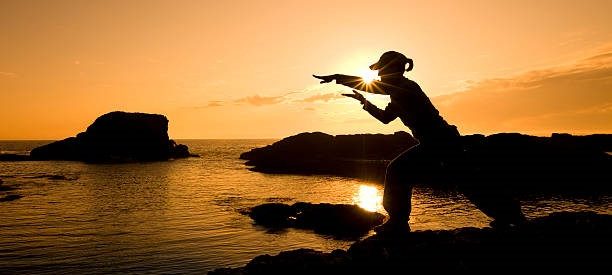
Living in Alignment With Nature – Part 1

Autumn has finally arrived here in Central Texas, with rain and temperatures more reflective of what Fall should feel like. We dropped from the 80s to the 50s in less than a day. With a cool North breeze to accentuate the shift.

Times like this, I am thankful for the wonderful Five Elements Daoyin (Wu Xing Jing) form I learned some years ago and include in my Qigong and Breathwork classes and private lessons. The Lung exercise, which is associated with the Metal element and the Fall season, is particularly important right now. Fall includes changing temperatures, changing wind directions, and changing energies, all of which can make you more susceptible to seasonal colds and flus, allergies, and even more serious illness. Unless, of course, you build RESILIENCE through healthy nutrition, good sleeping habits, and doing your Lung / Metal exercise on a regular basis.

(BTW, if you’re interested in learning more about this super effective, powerful, yet easy (and dare I say FUN) health practice, go here for more on the Five Elements / Wu Xing Daoyin form.)

With the cold comes more outside training. What? Outside? Don’t you mean more INSIDE training, Karen?

No I don’t. Our summers are so brutally and endlessly hot, and we typically have to time our outside exercise and other activities to the early mornings or late evenings. Now, with the onset of cooler / colder weather in the Fall and Winter, we can enjoy our activities outside at any time of the day.

And it’s important to align yourself with the changing weather by spending time outside. Walks, yard work, sitting out by the fire pit, practicing your Qigong or Tai Chi…it’s all good. We’ve become so insulated from the weather and the changing seasons in our air conditioned / heated buildings and houses. Get out there and get some wind on your face. Shiver a bit until you move and generate some heat.

In fact, I typically do even MORE Qigong sessions outside in the fall and winter than I do in the summer, when it’s easier. Years ago, one of my Qigong and Martial Arts instructors, Master Yoo, taught us to go outside in the early morning and practice our Qigong or martial arts. First thing in the morning, the air is fresher and cleaner. And you aren’t distracted by the tasks and cares of the day.

As he put it, even if the rest of your day “go to shit”, you still accomplished something very important to your health, productivity, and creativity. And you came through on a discipline and a commitment you made to yourself.

A key point Master Yoo hammered on was to do your Qigong outside, no matter the season or the temperature. That way, your body is exposed to the natural, seasonal cycles and becomes more quickly acclimated.

As an aside, Master Yoo was one of my favorite Ki Kung (Korean version of Qigong) and Hap Ki Do instructors. His dad was Korean and his mom was Chinese, as well as a highly respected master of Qigong and Kung Fu. While Master Yoo came up through the TaeKwonDo competitive ranks, his true loves were the exercises and forms his mom taught him. And he, in turn, taught us these ancient disciplines in the hopes we would benefit from them and carry them on to future generations.

Back to the weather…

Your ability to acclimate and adjust enhances your adaptability and therefore, your resilience. Modern science, especially in the field of psychoneuroimmunology, has “discovered” (in quotes because the Chinese beat them to this by about 5,000 years) that putting yourself through discrete bouts of stress – such as exercising in higher intensity bursts followed by rest intervals, or exposing yourself to cold for a period of time – actually trains your body and brain to adapt, so you get stronger and increase your capacity to handle even more stress the next time. These adaptations occur at all levels: physical, mental / emotional, even spiritual…and from the systemic (i.e., circulatory system, lymphatic system, digestive system, etc.) all the way down to the cellular level.

I’ll have more to say about living in alignment with nature in future posts. For now, be sure to get outside and get in sync with the current season, however it may be manifesting in your area of the world right now.

You Can Do It!

Dr. Karen

Stand Up and Move Forward

As I was walking the other day, I listened to the Audible version of Doris Kearns Goodwin’s latest book, “Leadership in Turbulent Times”.

I highly recommend the book. It focuses on four of our finest presidents – Abraham Lincoln, Teddy Roosevelt, Franklin Roosevelt, and Lyndon Johnson – and the “crucible” experience and hardship each went through to become an effective, even transformational, leader.

Goodwin’s description of Franklin Roosevelt’s being stricken with polio, and his long, difficult recovery and return to public political life, reminded me of the importance of our 8X meridians. Well, it reminded me of a lot more than that! But hey, I’m always mindful and making note of the energetic and qigong principles all around us.

Anyways, Franklin fought to develop his upper body and figure out how to leverage various tools, such as his heavy metal leg braces, so he could “walk” again. Of course, his walking involved the heavily demanding task of using crutches and his strengthened upper body to drag along his legs. Alternatively, he would walk arm in arm with one of his sons for support and drag those legs along.

His drive, determination, and innate optimism were incredible! Roosevelt was driven by his belief that he needed to be able to once again “stand upright” and “move forward” physically, to have any chance of acceptance and effectiveness as a political leader.

So, let’s discuss two sets of meridians that, along with our core 8X, enable us to physically and psychologically stand upright and move forward.

Our Beautiful Energetic Matrix

The “Between Heaven and Earth” form activates the Eight Extraordinary Meridians (the “8X”) which in turn strengthens our natural energy matrix and helps us stay healthy and resilient.

We build on our connection with Mother Earth and her life-giving yin energy. As we move through our day-to-day lives, we deal with the material, the substantial, the daily cares of living, and the to-do’s from our task list. However, every now and then, we should connect to Heaven to recharge and renew with that heavenly yang energy. This is where our inspiration and creativity come from.

The cycles of Earth and Heaven – yin and yang – work and recharge – activity and rest – doing and creating – mirror the universe around us. Through reflecting these cycles, the Between Heaven and Earth exercises provide a wonderful way to recharge.

As we wrap up our discussion of this form, I’d like to focus on two sets of the 8X meridians that don’t get as much attention: the Linking Vessels (Wei Mai) and the Heel Vessels (Qiao Mai). There is a Yin and Yang version of each of these, resulting in four meridians that combine to make a circuit that moves up the front of the body and down the back (or alternatively in the opposite direction).

Basically these meridians run from the end of the limbs (legs or arms) into the torso, and back to the limbs again. You can picture them as broad bands or thick hoses of energy that run along the center of your limbs and torso. Each of these connects with the core 8X meridians, including the Conception Vessel (Ren Mai) that runs along the front centerline; the Governing Vessel (Du Mai) that runs along the back centerline; and the Belt Vessel (Dai Mai) that connects like a wide belt or sash.

These core meridians form the beautiful energetic matrix or cage which embodies our constitutional energy. Our 8X are keys to our resilience, health, energy levels…as well as our ability to adapt, to overcome, to recover, and ultimately to come back stronger.

The Linking and Heel Vessels constitute what is called the “Macrocosmic Orbit” which is a circulation that moves energy from the limbs into the torso and then back out again to the limbs. This circulation promotes our ability to move and support our bodies. It also provides the means to move energy throughout our body, to help remove or reduce stagnation or blockages, repair or heal internally…and even project energy to help heal others.

“Endure Consistently and Confidently”

Beyond the physical and energetic constructs, our Linking and Heel Vessels also play crucial roles in our mental and emotional formation.

The Yin and Yang Wei Mai / Linking Vessels help to balance Yin and Yang and demarcate major transformations over time. The Wei Vessels provide the mechanism for significant change – for example, to reverse disease or pathology at any time; or to make significant changes to habits and lifestyle. This is your constitution, your innate ability, your “Optimistic Channel”.

Your Yin Wei Mai pertains to deep internal beliefs about your purpose and the meaning you ascribe to life. It provides drive and focus so you can get through almost any hardship.

Your Yang Wei Mai places you into the sea of possibilities. When you pair infinite possibilities with meaning, purpose, and validation, you generate a deep constitutional flow through which you give yourself permission to make your own choices in life. You can see the best possible outcome, and you free yourself to to do what you really want to do with your “one wild and precious life”, as Mary Oliver puts it.

The Yin and Yang Qiao Mai / Heel Vessels are how you stand up to the world. Do you have an internal locus of control? Can you set appropriate boundaries? What are you willing to grow into? They also reflect whether you are primarily an introvert (yin) or extrovert (yang). These vessels also affect your moral and ethical standards and form your internal compass.

Your Yin Qiao Mai is about understanding you are all potential and appreciating your light. It’s the depth of coming to realize and appreciate what you really offer to the world – AND your obligation to bring your gifts out into the world. Key point: Don’t underestimate or dismiss your light. Appreciate your unique gifts and abilities.

Your Yang Qiao Mai is about shining your light out into the world. It’s how you manifest in the world, how you show up. Are you overly worried or concerned about other peoples’ judgments or how you are being received? Or have you grown and matured enough to just say “NEXT!” at any rejection and keep on moving and showing up? Key point: Don’t hide your light! Let your gifts shine out in the world – we need them! We need that unique and wonderful YOU to show up!

You Can Do It!

Dr. Karen

“Endure consistently and confidently. Keep walking – keep moving toward ‘The Next One” [i.e., your next goal or important work or achievement]. Because walking means change is possible.“

-Masaaki Hatsumi, Soke (Head Instructor) of the Bujinkan Dojo and 34th Soke of Togakure Ryu Ninjutsu

Digest the Gristle: The Earth / Spleen Element and Transformation

We’re moving more fully into Fall now, so let’s complete our discussion of the Late Summer / Earth Element by discussing aspects of Earth / Spleen energetics and the emotional, mental, and spiritual aspects of transformation.

Just as we digest, assimilate, and obtain nourishment through the Stomach and Spleen organ system for our physical bodies, so do we digest and assimilate our experiences, whether good, neutral, challenging, or even traumatic. When our Spleen / Stomach energies are balanced and regulated, we can “digest the gristle” – that is, take from the experience the lessons learned, the “nourishment” to help us grow and get better, the impetus towards the transformation that may be required based on our new knowledge. And we also eliminate that which does not serve or help us.

If we are out of balance – for example, if we are living in a stressed-out state of mind and being or suffering from a chronic health condition – we may have difficulty assimilating nourishment from our challenges. We may embrace lessons that contract or constrict our world view, rather than expand it. We may lack confidence to move forward in life. We may find ourselves unable to trust – we don’t trust other people, and we don’t trust our own gut or intuition. We lose faith in ourselves and our ability to move forward.

In Classical Chinese Medicine (CCM), the Spleen (Yin organ) and Stomach (its Yang organ pair) are intimately connected. The Stomach receives nourishment and begins the digestive process; the Spleen transforms this nourishment into Qi / energy and blood, and then transports the Qi and blood throughout the body. Stomach and Spleen create a dynamic balance between giving and receiving.

The key qualities of the Earth element are nourishment and stability. When our Earth element is balanced and stable, we easily transform food into nourishment and experiences into lessons-learned and growth. We feel well-nourished and grounded within our body. Our Earth energy provides the stable platform from which to trust ourselves, our gut, our intuition. And we can attend to others, giving support, encouragement, and nurturing.

When our Earth element is out of balance, we are unable to transform or assimilate food or experiences. We feel unstable and ungrounded. Our mind may go around and around in an endless cycle of excessive rumination. This can include rumination and overthinking about something that just happened, so we can’t digest and learn from it. This can also include obsessing or excessive worry about an event (either real or imagined) yet to come.

As a result, we never get off the dime. Our natural Yi or intention, also associated with the Spleen / Stomach, becomes weak. Our Yi influences our capacity for thinking, concentrating, and studying. It helps us think through our life experiences. If our Yi is weak or unbalanced, we won’t learn our lessons, and we may make the same mistakes, over and over again. We also lose motivation and become less resilient.

Earth’s Connection to Our North Star

Within Daoist teachings, the Earth element is associated with the North Star. How so? Well, first, visualize yourself standing on the stable, solid earth under your feet – this is the grounded state of trusting yourself. Then form a triangle with the thumb and forefinger of each hand and raise your arms straight up above you. Now look up through the triangle to the North Star. Set your ultimate goals, your intention (or Yi) square within your sights. Your “True North” helps guide you through life, through the challenges, the lessons learned, the detours. As long as you can stay grounded and have a place to stand, you can figure out a way through.

Or, as Casey Kasem used to say, “Keep your feet on the ground and keep looking at the stars”.

So, you see how important the Earth / Spleen element is to our growth and transformation. Its key virtue is Trust: trust in ourselves, as well as our ability to trust in others.

Trusting oneself to learn, to grow, to be able to handle new situations and challenges. Going deep inside and listening to what our gut is telling us (i.e., the enteric nervous system which has more neurons than the brain). Using this as the stable ground from which we set our intention and purpose and move forward in life. Good stuff!

How to Boost and Balance your Spleen / Earth Element

The Wu Xing / Five Elements exercise for Earth / Spleen is a simple yet powerful movement for building this energy within yourself.

Earth elemental energy rises from the level of the Spleen and Stomach and then divides as it reaches the top of the thrusting meridian (Chong Mai), which moves up through the center of the body. This yellow, dividing energy exists at the point of change or transformation of the other elements.

In the Earth / Spleen exercise, we use movement and intention to pull up energy from the ground / earth through our core, through the level of the Spleen and Stomach, up to the point at which the energy divides at the center point of change between the other elements. The nice stretch and twist of this exercise also directly activate the Spleen and Stomach meridians.

If you’re interested in learning more about the Five Elements exercises, visit the Wu Xing / Five Elements Course page.

You Can Do It!

Dr. Karen

What Should I Be Eating Right Now?

Nutrition, digestion, and nourishment are central foundations of life. Life is impossible without the Earth Element function to receive food (and drink), transform it into Qi and blood, and transport the Qi and blood throughout the body.

Even though winter seems far away right now, Late Summer is a crucial time of preparation for the colder weather. As we follow the seasonal cycle, we focus on the Spleen and Stomach organ system during this time because it’s important that we eat in order to prepare our bodies for winter and hibernation.

Of course, in modern times, as denizens of rich western societies, we no longer must prepare ourselves for lean times and curtailed food choices or availability in winter. In fact, many of us put on some pounds during winter because we aren’t as active and aren’t going outside as much.

However, you can still follow the natural cycles and phases of nature…and you will be all the healthier for it!

So, what do we eat to help regulate and balance our Earth element – our Spleen and Stomach? The Spleen and Stomach like “sweet” foods. Late summer is a time of harvesting and gathering, so we eat late summer corn, fruits, and grains. Sweet foods that strengthen the Earth element include whole grains like millet and rice, and root vegetables such as yams, sweet potatoes, and carrots.

“Sweet” in Classical Chinese Medicine also refers to certain meat dishes, such as rich beef stews with vegetables. Think of dishes that soothe and nourish, and you are on the right track.

Most of us are still active this time of year. Yes, the kids are back in school and many of us are back to a regular work schedule, so we may feel time starved. But it’s important to continue to get outside and get that natural Vitamin D – and equally important to maintain physical activity. Physical activity helps ensure regular peristaltic activity in the stomach, intestine, and colon supporting good digestion, assimilation, and elimination.

The mouth is the sensory organ related to the Spleen. Issues such as chronic bad breath or bleeding gums could be a sign of deficient Spleen / Stomach function.

The muscles are the tissue associated with the Spleen. Think about the healthy folks you know. They likely have a strong, balanced Spleen and Stomach. The ability to maintain or build muscle mass means your digestive function is working and you can process the protein you eat into amino acids that help build and repair body structures as well as important enzymes that support critical processes.

Now think about someone you know who has difficulty gaining or maintaining weight. This person could have digestive troubles and be weak or out of balance in their Spleen and Stomach organ system.

How to Boost and Balance your Spleen / Earth Element

In addition to “eating for your Spleen” (that sounds like a wonderful tagline for a promotional campaign), you can also practice the Wu Xing / Five Elements exercise for Earth / Spleen.

Earth elemental energy rises from the level of the Spleen and Stomach and then divides as it reaches the top of the thrusting meridian (Chong Mai), which moves up through the center of the body. This yellow, dividing energy exists at the point of change or transformation of the other elements.

In the Earth / Spleen exercise, we use movement and intention to pull up energy from the ground / earth through our core, through the level of the Spleen and Stomach, up to the point at which the energy divides at the center point of change between the other elements. The nice stretch and twist of this exercise also directly activate the Spleen and Stomach meridians.

If you’re interested in learning more about the Five Elements exercises, visit the Wu Xing / Five Elements Course page.

In our next post on the Earth Element, we will go deeper into the Earth / Spleen energetics and the emotional, mental, and spiritual aspects of transformation.

How to Leverage Structural Tension

There is a wonderful framework used by artistic creators called “Structural Tension”.

Within this framework, the artist or writer or other creator focuses on two ends of the creative spectrum or process.

The first point of focus is the vision for what they wish to create.

The second point of focus is on where they are now, or the starting point.

Creative tension results from the dissonance or distance between where the creator wants to go – their vision of their finished creation – and the beginning of the creative process.

As long as the artist or creator stays focused on their vision or goal, they maintain the creative tension. And by tension, I don’t mean something negative. It’s more like a “pulling toward” feeling, by which the creator invests emotional, mental, and sometimes physical energy into the process, so they stay on track and, bit by bit, chip away at what they are working on.

Each of us can use this Structural Tension framework as we approach our own goals, dreams, and vision for our lives.

Medium to longer-term goals may require that you operate on a lower but more constant level of creative tension or energy. You feel the dissonance between where you are now and where you want to go or what you want to manifest in your life. And at times, you may lose the feeling as you focus on shorter-term goals or current life problems or challenges.

Eventually, you will come back to that goal or dream. It’s always there, percolating under the surface.

Get back in gear by renewing the creative tension. Allow yourself to feel the pull of the goal and the emotions of wanting to achieve it. Bask in the feelings you will experience once you have it. Then begin. Take a small step today from where you are today.

As Teddy Roosevelt, 26th President of the United States, said, “Do what you can, with what you have, where you are.”

Creative Tension in Our Practice

We practice within this Creative Tension framework every time we do our Qigong and related dynamic exercises.

In fact, our standing practice helps us to develop structural tension and stability – what’s known as “tensegrity” – so we feel more stable and grounded and can stand for extended periods of time. This in turn strengthens the supporting structures and allows the body to open so the energy can flow.

We strive to stay relaxed… yet we also learn to focus our mind and intention. We stand still in our Wuji stance… yet the energy flows and tingles throughout our body.

In many of our forms (such as the Yi Jin Jing or Muscle-Tendon Changing Classic), we stretch to create structural tension on our ligaments, tendons, fasciae, bones, and muscles…then we release that tension into relaxation or into movement in another plane or direction.

Tension, relaxation, tension, relaxation…stretch, relax, stretch, relax…inhale, exhale, inhale, exhale…rhythmic cycle after cycle after cycle.

These instances of “micro” structural tension – relaxation cycles help condition us and improve our abilities to leverage creative tension in all areas of life, helping us bring into being the person we want to be and the contributions we want to make.

You Can Do It!

Dr. Karen

Qigong and What Else?

Practicing Qigong is a fun, wonderful, fulfilling, and minimal impact way to stretch and strengthen without the potential risk of injury from other exercise modalities.

In addition to moving forms, such as the Ba Duan Jin (Eight Pieces of Brocade) and Yi Jin Jing (Muscle-Tendon Changing Classic), standing practices also improve our strength and flexibility. In fact, as you progress in your Qigong, you will find that your standing practice, coupled with the internal work (Neigong) that you do while standing, becomes the more important and profound aspect of your practice and development.

Having said that, I also feel it critical to point out the following: Qigong practice alone is not enough!

This may go against the grain of some purists, but it’s true.

You must also include other types of strength and aerobic capacity-building exercise to help ensure you stay fit and strong, as well as help recover from or prevent the common injuries and complaints many people experience as they get older. We’re talking resilience against back problems, knee problems, osteoporosis, diabetes, early aging, etc., etc., etc. We’re talking improving your capacity to adapt. We’re talking quicker, easier recovery if you do become injured or ill.

Dynamic Energy Exercise

This is so important that, years ago, I developed an approach to fitness for myself that included the major components that help develop resilience, capacity, and improved health and energy. I called it “Dynamic Energy Exercise” and it proved so effective for me and my clients and students, that I actually registered it with the US Patent Office.

Dynamic Energy Exercise™ is an approach to exercise and wellbeing that integrates your body, mind, and spirit through the focal point of your breath. It leverages time-tested principles and techniques from Qigong and other energy disciplines, breathing methods and practices, and traditional martial arts. It’s grounded in years of study and teaching, rigorous and ongoing education in Medical Qigong and Classical Chinese Medicine, and continued practice and evolution. It’s extremely effective yet easy to learn and accessible to anyone.

If you’re interested in learning more about it, visit my other website, www.BestBreathingExercises.com.

Anyways, I mention this because I’ve learned from first-hand experience that following a well-rounded program is key to avoiding injuries, getting stronger and fitter, and staying younger and more energetic. Qigong and breathwork are at the heart of this type of program, of course. Then you want to add the other components. AND be efficient in your program so you’re not tasking yourself with having to work out all the time.

An example I am super familiar with is studying martial arts, especially more traditional approaches. For years I have studied Uechi-Ryu Karate (a traditional Okinawan style with roots in Southern China) and a traditional form of Tae Kwon Do. (I took some time off from martial arts when I became a mom but have been back in the saddle the past few years.)

My instructor, Grandmaster George Mattson, is considered the “Father of Uechi-Ryu Karate in America”, because he first brought Uechi to the U.S. back in the late 1950s, and over the years has run dojos, online schools, tournaments, and been a wonderful role model and ambassador of the style. Mattson Sensei continually stresses the importance of supplemental training as a complement and support to our Uechi-Ryu. In Uechi we train for fighting, self-defense capabilities, and self-development. We perform body conditioning and special breathing exercises. AND… we supplement this with exercises such as calisthenics, lifting and manipulating weights and weighted tools, and aerobic exercise to help build up our bodies.

Your Body is a Temple

Centuries ago, a wise sage traveled to a reknowned monastery to teach his version of Buddhism. When he arrived, he found the monks to be so focused on their spiritual practices, which involved copious time spent sitting and meditating, that they had allowed their bodies and health to deteriorate. The wise sage knew they would never reach their spiritual goals unless they also built up their physical and mental health and capacities.

And so (it is said), he developed the Yi Jin Jing (Muscle-Tendon Changing Classic) to help the monks build their strength and flexibility, begin to flow internal energy, and gain an appreciation for the physical aspect of their being. (This wise sage is also said to have developed a second classic Qigong practice, which we’ll get into at another time.)

The wise sage knew that the physical, mental/emotional, and spiritual are all tied together. In fact, many believe they are all…the same thing.

It would seem to make sense to embrace all three within your own health practice, wouldn’t it?

You Can Do It!

Dr. Karen

Two Keys to Breathing Better

If you want to improve the functioning of your lungs and your ability to pull in more life-giving, energy-stoking oxygen, you need to focus on two major areas.

The first is to develop the muscles and structures that support proper, healthy breathing.

The lungs have no muscles of their own. Their expansion and contraction are completely dependent on the muscles surrounding the rib cage and the diaphragm. You need to build up the strength and coordination of the structures that support proper, full breathing.

The second major area that affects your breathing has to do with what goes on inside your lungs. This includes your vital capacity and the residual air that remains in your lungs when breathing. The size of the lungs varies from person to person. But each of your lungs is about the size of a football.

Isn’t that funny? The first time I heard that, I thought “My lungs aren’t that small!” A football just doesn’t seem that big to me.

Naturally, a larger person will have larger lungs than a smaller person. Men have larger lungs than women. So there are some natural limits to lung capacity.

However, lung size is not as important as the total capacity of your lungs that you can use. This usable portion is called your vital capacity. A well-conditioned person’s vital capacity is about 75 percent of his or her total capacity.

When you exhale, you breathe out all the air you can from your lungs. The remaining air is called the residual volume. This is air that remains fixed in your lungs. You may have heard it referred to as “stale air”.

Too much residual volume is unhealthy. If you are inactive for any length of time, or you have a respiratory condition that is not well-controlled, the unusable portion of your lungs may increase. This physically blocks off more of your airways, which leaves less space for normal breathing – and makes it even more difficult to breathe when exerting yourself. You may get to the point that just climbing a flight of stairs leaves you breathless.

Unless you do something, this breathlessness and chest tightness will keep getting worse and worse. These two key areas – developing the structures that support proper, healthy breathing and improving your vital capacity – are the same areas we work on with the dynamic energy exercises I teach in my classes and through my programs. We’re talking simple, ancient, time-tested breathing and energy exercises that work – AND leave you feeling great!

An effective fitness program can help you improve your ability to breathe, build your vital capacity, and reduce the residual volume. However, many people do not breathe correctly when they exercise. In fact, unless you seek out this information, you likely have not been taught how to breathe to maximize the results you get from exercise.

Increasing the efficiency of your breathing and your ability to allow things to open up in a relaxed manner is a surefire way to target, develop and maximize the work performed by your lungs, as well as the structures that support proper breathing. If you’re serious about improving your physical condition and your health, you should make it a point to focus on expanding your vital capacity and ability to breathe properly. This type of dynamic breathing exercise will help you get fit more quickly. And it provides the foundation for robust health and longevity. AND – key point – it makes you feel great!

If you’ve thought about exploring breathwork…you’re interested in developing your breathing ability…or you’d love to enhance your health and energy levels, try my Introductory Program, “Breathing & Qigong for Health and Energy – 4 Week Introductory Course“.  This program will introduce you to a proven health and energy cultivation method impacting body, mind, and spirit. It’s easy to do and only takes a few minutes per day. I personally send you a new lesson each week, but you can learn and enjoy at your own pace. Click here for more details or to order.

You Can Do It!

Dr. Karen

Be In the Moment

Are you present in the moment?

Or are you doing one thing and thinking about something else? Or thinking about what you’ll do next? Or worrying about some future event that may or may not occur?

A fundamental teaching of the major religions – especially Eastern traditions such as Daoism and Buddhism – is to be present in the now. Fully live and experience life by being present with whatever you are doing.

This is wonderful advice if you are looking to improve your performance in any area of your life. Whether at work, developing a new skill, spending time with one of your kids or grandkids, or doing something simple like washing the dishes…being fully present and doing ONE THING AT A TIME is a secret to doing that thing better, AND enjoying it more.

And how many times have you worried or ruminated about someone, something, some event that might occur or that you might have to deal with. Only to find the event or terrible thing did not occur as you had feared. How many wasted minutes and hours have you lost doing this…have I lost doing this?

As Mark Twain famously said, “I am an old man and have known a great many troubles, but most of them never happened. Worrying is like paying a debt you don’t owe. I have spent most of my life worrying about things that have never happened.”

Pets Are Great Teachers

I find the best teachers of the principle of being in the moment are our pets. Dogs and cats provide wonderful examples of being fully present, giving unconditional love to those around them, and being fully invested in whatever they are doing. Could be walking, could be playing, could be taking a nap. Doesn’t matter, they are 100% there! And they usually are having a jolly good time too!

We are blessed with two dogs and four cats. Here is our youngest – the baby of the family – Ciara (which means “Dark-Haired One” in the Celtic language):

Here is Miss Ciara on the move in our back yard. She’s practicing her scary face as she, through play, learns her hunting skills. (So far no kills!) She runs and climbs and plays with her sister cats – what experts call “The Zoomies” – for a half hour, hour at a time. Then…

Time for a nap with big sister Stella. And she is OUT for an hour or more.

It’s Even Biblical

Jesus taught the importance of being in the moment and fully present. In Matthew 6:34, Jesus tells us “Therefore do not worry about tomorrow, for tomorrow will worry about its own things.”

Being fully present in the moment is a skill or capability you can develop. When we practice our Qigong, do some deep breathing, or engage in deep prayer or meditation, we focus internally and fully inhabit the present. When we find our thoughts drifting to “What’s next?” or “What should I have for lunch?” or “How the heck am I going to deal with X problem?”…we gently coax our thoughts back to our practice – our breathing, our intention, our movement.

Yes, you can be happy and content TODAY. You can be grateful in this moment. You can inhabit the present and invest your attention and energy in such a way that you feel relaxed, you feel the flow, even as you allow yourself to experience FREEDOM from anticipating and worrying about what’s ahead.

Want to Live Longer? Live Near Green Spaces…

...AND make friends with a tree

The Washington Post published an article yesterday titled, “Living Near Green Spaces Could Add 2.5 Years to Your Life, New Research Finds” (you can read the article here).

They go on to discuss an article in the journal Science Advances which suggests long-term exposure to more greenery where you live can add an average of 2.5 years to your life. The study looked at long-term exposure to surrounding green spaces among a group of more than 900 people in four U.S. cities. They found that being near green space causes “biological or molecular changes that can be detected in our blood”.

Well, I’m happy that modern science continues to catch up with ancient medical wisdom. For centuries, our Classical Chinese Medicine (CCM) paradigm has educated us on the importance of staying close to nature. Taoist practices have had a major influence on CCM and Taoism is all about simplicity, staying close to nature, and following nature’s rhythms and cycles.

In CCM, we teach that the blood and the Qi are synonymous and how important it is that both flow without obstruction or stagnation. Blood and Qi are energy, information, communication, and alimentation (i.e., nourishment) for every structure in our bodies and brains. One of the wonderful benefits of our Qigong practice is an increase in the circulation of blood and qi along with a concurrent decrease in stagnation or blockages. So it’s interesting to hear of a study that identifies actual markers in the blood that indicate a younger biological age due to living closer to green spaces.

When I teach Qigong, I make sure that the participants and I center and ground in every single session. It’s such an important skill, not just in our energetic work – it’s an essential life skill too! As the students in my group and private classes will tell you, I often encourage them to go outside in their bare feet and engage in a few minutes of conscious breathing, centering, and grounding. It’s much easier to feel or become aware of the Yin energy coming up from the earth and to get into a grounded state when you connect directly with the ground. It’s such a pleasant, wonderful feeling too!

Say Hello to Your Big Friend

To turbo-charge your practice, choose a spot close to a tree. Stand with feet about shoulder width apart or in your Wuji posture and follow your

process of breathing, focusing inside, centering into the lower abdomen (or heart center if you prefer), and ground via the Kidney 1 (Bubbling Well) point in the bottom of each foot. Imagine your feet are projecting a tap root down into the earth, so you feel fully rooted. And see or sense your tap roots are becoming intertwined with the roots of the tree.

Feel the energies of your root system commingle with the energies of the tree’s root system. Then inhale deeply into your lower abdomen. At the same time, allow the Yin energy of the earth to come up through your roots and your Kidney 1 point, up through your legs, and into your lower abdomen (lower dan tien or energy center). Gently “fill up the bathtub” in your lower abdomen.

With each exhale, allow the energy to drop back down through Kidney 1 into the earth. As the energy drops, release and purge any unwanted stagnation, stiffness, tightness, blockages, emotional content, or thoughts that are not serving you well. Let it all drop into the earth.

Then take a fresh breath and repeat the cycle.

Obviously, there are some subtleties and finer points to doing this. But don’t worry about that for now. Keep things simple.

As you repeat cycles of inhalation and exhalation, pulling energy in and allowing energy to drop and release, you may get into a profound state of grounding. You are also sharing or cycling energy with your new friend, the tree. This results in profound physical, mental, and emotional benefits, which we will discuss in our next post.

In the meantime, get back to nature, find a new friend – er, tree – and allow yourself the pleasure of interacting in a whole new way.

Can Better Posture Improve Your Health? Part 2

Posture doesn’t receive enough attention. Some years ago, I began to attend to my posture more consistently. I’m still not perfect, but I constantly work on it!

When I was in college, I was hit by a car. Unfortunately, the car won. I had a lingering back injury that forced me to pay attention to how I stand and sit.  Later, when I began to explore various causes and solutions for my adult-onset asthma, I realized that my posture had a huge impact on how well I was able to breathe.

Today, I always pay attention to how people carry themselves when they are exercising. To my dismay, I see a lot of hunching and rounded backs when people are walking, jogging, or lifting weights. Not good!

Your posture is one of the master keys to abundant health and energy

Keeping an upright posture with good spinal alignment is key to avoiding injury, performing well, and getting reliable results from exercise. It also helps you feel more powerful and in control – not only when exercising, but in all areas of your life. And possessing an enhanced sense of power and control is something we can all appreciate.

The spinal cord is a critical communications channel. It’s not just a passive channel for transmitting information – it’s actively involved in transposing and making sense of the information and sensations coming in from our nervous system, as well as other sensory organs.

Your posture has a direct effect on your spine’s ability to conduct and intelligently monitor that information.

In addition, the way you hold your head directly impacts your brain’s ability to think. The poor habitual posture we may develop over the years leads to our head slumping forward. And when you lose this base postural support, you impede the flow of blood, lymph, and nerve impulses to and from your brain – resulting in brain fog, low energy, and even chronic headaches.

Posture in Qigong

When we practice our Qigong, we maintain a relaxed but upright posture. When standing, we create a gentle extension of the spine by turning our hips slightly forward and imagining the crown of our head is suspended by a string from the ceiling, and/or gently tucking our chin. This ensures the optimal alignment of spine / back, neck, and head, which not only facilitates the health of the spine, but also helps us maintain the standing posture for time because our frame and weight are aligned and supported.

When moving in Qigong, we typically maintain good posture and a straight line from lower back through torso through neck. With some movements, we perform subtle to more pronounced flexion and extension of the spine, which helps to stretch and strengthen the paravertebral structures supporting the spine as well as open the meridians associated with the spine. Energetically, spinal movements impact the Chong Mai or Thrusting Meridian, Du Mai or Governing Meridian, and Ren Mai or Conception Meridian. The Dai Mai or Belt Channel also gets some excellent work from many of the movements that exercise the spine.

As part of our preparation, we also perform loosening exercises which ensure articulation of the hips, spinal column, and neck.

Each one of these components is important in protecting, strengthening, and enhancing our spine and back and helping ensure the health of this critical communications and structural support component of the body. Not only does this help us move and feel better today…it also helps us stay younger.

As you go about your day, pay attention to your posture as you sit, stand, or walk. Leverage your Qigong to help reinforce specific postural elements and then see if you can carry these over to everyday activities.

And here’s a little secret: attending to your posture – not all the time, but just as a checking in type process – will help you become more mindful.