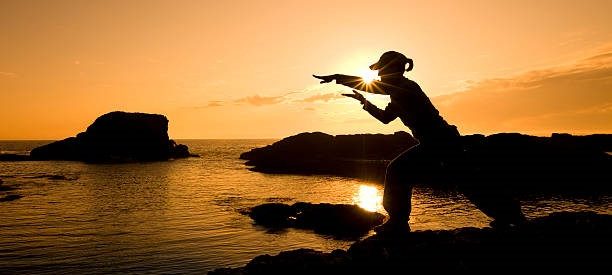
Resonate With the Earth

In my last post, I discussed the importance of Grounding and getting in touch, both physically and energetically, with the energy of the Earth.

And as I mentioned, in my online video course, “Introduction to Qigong and Breathwork“, I included an easy, fun Grounding meditation. Did you check it out yet? If not, please do so.

Here’s an additional “Fun Fact to Know and Tell”:

The Earth has a natural electromagnetic frequency of 7.83 Hertz. This is called the Schumann Resonance and is also referred to as the “Earth’s heartbeat”.

Did you know that the human brain, in a healthy state, also resonates at a frequency of 7.83 Hertz? Not a coincidence!

Our brains, indeed our entire electromagnetic and biophotonic selves, are in a natural state of resonance with the Earth. In fact, the Schumann Resonance is thought to affect our health and wellbeing, including our sleep, mood, and even consciousness.

This is why we often feel good when we are out in Nature, as it allows us to get connected to the Earth’s frequency and essentially become entrained with the Earth. This in turn has a positive effect on our moods and emotions and promotes a feeling of wellbeing and calmness.

WARNING: Interrupted Transmission

However, if you live in an urban environment, or a suburban area that is undergoing development, you are subject to human-generated EMF emissions – from radios, cell phone towers, and the electricity that hums around us in our homes and offices. These types of EMFs are NOT at 7.83 Hertz and are NOT in synch with our natural frequency. They can crowd out the Schumann Resonance, leaving you feeling depleted, moody, low energy, etc. etc.

Getting back into resonance with the Earth is easy. Make it a habit to sit our stand outside in your bare feet (or socks if it’s cold), preferably in the vicinity of trees. Breathe naturally and deeply and relax. Do your grounding meditation or just sit and enjoy. This is just about the easiest health practice I can possibly recommend, but it’s also one of the most powerful!

To show you just how easy it is, please see the photo below. This is Zuzu and Clinty sitting in their favorite spot, grounding and resonating with the Earth. They look pretty happy don’t they?

Stand Up and Move Forward

As I was walking the other day, I listened to the Audible version of Doris Kearns Goodwin’s latest book, “Leadership in Turbulent Times”.

I highly recommend the book. It focuses on four of our finest presidents – Abraham Lincoln, Teddy Roosevelt, Franklin Roosevelt, and Lyndon Johnson – and the “crucible” experience and hardship each went through to become an effective, even transformational, leader.

Goodwin’s description of Franklin Roosevelt’s being stricken with polio, and his long, difficult recovery and return to public political life, reminded me of the importance of our 8X meridians. Well, it reminded me of a lot more than that! But hey, I’m always mindful and making note of the energetic and qigong principles all around us.

Anyways, Franklin fought to develop his upper body and figure out how to leverage various tools, such as his heavy metal leg braces, so he could “walk” again. Of course, his walking involved the heavily demanding task of using crutches and his strengthened upper body to drag along his legs. Alternatively, he would walk arm in arm with one of his sons for support and drag those legs along.

His drive, determination, and innate optimism were incredible! Roosevelt was driven by his belief that he needed to be able to once again “stand upright” and “move forward” physically, to have any chance of acceptance and effectiveness as a political leader.

So, let’s discuss two sets of meridians that, along with our core 8X, enable us to physically and psychologically stand upright and move forward.

Our Beautiful Energetic Matrix

The “Between Heaven and Earth” form activates the Eight Extraordinary Meridians (the “8X”) which in turn strengthens our natural energy matrix and helps us stay healthy and resilient.

We build on our connection with Mother Earth and her life-giving yin energy. As we move through our day-to-day lives, we deal with the material, the substantial, the daily cares of living, and the to-do’s from our task list. However, every now and then, we should connect to Heaven to recharge and renew with that heavenly yang energy. This is where our inspiration and creativity come from.

The cycles of Earth and Heaven – yin and yang – work and recharge – activity and rest – doing and creating – mirror the universe around us. Through reflecting these cycles, the Between Heaven and Earth exercises provide a wonderful way to recharge.

As we wrap up our discussion of this form, I’d like to focus on two sets of the 8X meridians that don’t get as much attention: the Linking Vessels (Wei Mai) and the Heel Vessels (Qiao Mai). There is a Yin and Yang version of each of these, resulting in four meridians that combine to make a circuit that moves up the front of the body and down the back (or alternatively in the opposite direction).

Basically these meridians run from the end of the limbs (legs or arms) into the torso, and back to the limbs again. You can picture them as broad bands or thick hoses of energy that run along the center of your limbs and torso. Each of these connects with the core 8X meridians, including the Conception Vessel (Ren Mai) that runs along the front centerline; the Governing Vessel (Du Mai) that runs along the back centerline; and the Belt Vessel (Dai Mai) that connects like a wide belt or sash.

These core meridians form the beautiful energetic matrix or cage which embodies our constitutional energy. Our 8X are keys to our resilience, health, energy levels…as well as our ability to adapt, to overcome, to recover, and ultimately to come back stronger.

The Linking and Heel Vessels constitute what is called the “Macrocosmic Orbit” which is a circulation that moves energy from the limbs into the torso and then back out again to the limbs. This circulation promotes our ability to move and support our bodies. It also provides the means to move energy throughout our body, to help remove or reduce stagnation or blockages, repair or heal internally…and even project energy to help heal others.

“Endure Consistently and Confidently”

Beyond the physical and energetic constructs, our Linking and Heel Vessels also play crucial roles in our mental and emotional formation.

The Yin and Yang Wei Mai / Linking Vessels help to balance Yin and Yang and demarcate major transformations over time. The Wei Vessels provide the mechanism for significant change – for example, to reverse disease or pathology at any time; or to make significant changes to habits and lifestyle. This is your constitution, your innate ability, your “Optimistic Channel”.

Your Yin Wei Mai pertains to deep internal beliefs about your purpose and the meaning you ascribe to life. It provides drive and focus so you can get through almost any hardship.

Your Yang Wei Mai places you into the sea of possibilities. When you pair infinite possibilities with meaning, purpose, and validation, you generate a deep constitutional flow through which you give yourself permission to make your own choices in life. You can see the best possible outcome, and you free yourself to to do what you really want to do with your “one wild and precious life”, as Mary Oliver puts it.

The Yin and Yang Qiao Mai / Heel Vessels are how you stand up to the world. Do you have an internal locus of control? Can you set appropriate boundaries? What are you willing to grow into? They also reflect whether you are primarily an introvert (yin) or extrovert (yang). These vessels also affect your moral and ethical standards and form your internal compass.

Your Yin Qiao Mai is about understanding you are all potential and appreciating your light. It’s the depth of coming to realize and appreciate what you really offer to the world – AND your obligation to bring your gifts out into the world. Key point: Don’t underestimate or dismiss your light. Appreciate your unique gifts and abilities.

Your Yang Qiao Mai is about shining your light out into the world. It’s how you manifest in the world, how you show up. Are you overly worried or concerned about other peoples’ judgments or how you are being received? Or have you grown and matured enough to just say “NEXT!” at any rejection and keep on moving and showing up? Key point: Don’t hide your light! Let your gifts shine out in the world – we need them! We need that unique and wonderful YOU to show up!

You Can Do It!

Dr. Karen

“Endure consistently and confidently. Keep walking – keep moving toward ‘The Next One” [i.e., your next goal or important work or achievement]. Because walking means change is possible.

-Masaaki Hatsumi, Soke (Head Instructor) of the Bujinkan Dojo and 34th Soke of Togakure Ryu Ninjutsu

Qigong and What Else?

Practicing Qigong is a fun, wonderful, fulfilling, and minimal impact way to stretch and strengthen without the potential risk of injury from other exercise modalities.

In addition to moving forms, such as the Ba Duan Jin (Eight Pieces of Brocade) and Yi Jin Jing (Muscle-Tendon Changing Classic), standing practices also improve our strength and flexibility. In fact, as you progress in your Qigong, you will find that your standing practice, coupled with the internal work (Neigong) that you do while standing, becomes the more important and profound aspect of your practice and development.

Having said that, I also feel it critical to point out the following: Qigong practice alone is not enough!

This may go against the grain of some purists, but it’s true.

You must also include other types of strength and aerobic capacity-building exercise to help ensure you stay fit and strong, as well as help recover from or prevent the common injuries and complaints many people experience as they get older. We’re talking resilience against back problems, knee problems, osteoporosis, diabetes, early aging, etc., etc., etc. We’re talking improving your capacity to adapt. We’re talking quicker, easier recovery if you do become injured or ill.

Dynamic Energy Exercise

This is so important that, years ago, I developed an approach to fitness for myself that included the major components that help develop resilience, capacity, and improved health and energy. I called it “Dynamic Energy Exercise” and it proved so effective for me and my clients and students, that I actually registered it with the US Patent Office.

Dynamic Energy Exercise™ is an approach to exercise and wellbeing that integrates your body, mind, and spirit through the focal point of your breath. It leverages time-tested principles and techniques from Qigong and other energy disciplines, breathing methods and practices, and traditional martial arts. It’s grounded in years of study and teaching, rigorous and ongoing education in Medical Qigong and Classical Chinese Medicine, and continued practice and evolution. It’s extremely effective yet easy to learn and accessible to anyone.

If you’re interested in learning more about it, visit my other website, www.BestBreathingExercises.com.

Anyways, I mention this because I’ve learned from first-hand experience that following a well-rounded program is key to avoiding injuries, getting stronger and fitter, and staying younger and more energetic. Qigong and breathwork are at the heart of this type of program, of course. Then you want to add the other components. AND be efficient in your program so you’re not tasking yourself with having to work out all the time.

An example I am super familiar with is studying martial arts, especially more traditional approaches. For years I have studied Uechi-Ryu Karate (a traditional Okinawan style with roots in Southern China) and a traditional form of Tae Kwon Do. (I took some time off from martial arts when I became a mom but have been back in the saddle the past few years.)

My instructor, Grandmaster George Mattson, is considered the “Father of Uechi-Ryu Karate in America”, because he first brought Uechi to the U.S. back in the late 1950s, and over the years has run dojos, online schools, tournaments, and been a wonderful role model and ambassador of the style. Mattson Sensei continually stresses the importance of supplemental training as a complement and support to our Uechi-Ryu. In Uechi we train for fighting, self-defense capabilities, and self-development. We perform body conditioning and special breathing exercises. AND… we supplement this with exercises such as calisthenics, lifting and manipulating weights and weighted tools, and aerobic exercise to help build up our bodies.

Your Body is a Temple

Centuries ago, a wise sage traveled to a reknowned monastery to teach his version of Buddhism. When he arrived, he found the monks to be so focused on their spiritual practices, which involved copious time spent sitting and meditating, that they had allowed their bodies and health to deteriorate. The wise sage knew they would never reach their spiritual goals unless they also built up their physical and mental health and capacities.

And so (it is said), he developed the Yi Jin Jing (Muscle-Tendon Changing Classic) to help the monks build their strength and flexibility, begin to flow internal energy, and gain an appreciation for the physical aspect of their being. (This wise sage is also said to have developed a second classic Qigong practice, which we’ll get into at another time.)

The wise sage knew that the physical, mental/emotional, and spiritual are all tied together. In fact, many believe they are all…the same thing.

It would seem to make sense to embrace all three within your own health practice, wouldn’t it?

You Can Do It!

Dr. Karen

Plucking Your Strings

When we think about Qigong or Breathwork, we often focus on the internal benefits we derive from the induction of vital energy, or qi, caused by the combination of movement, breathing, and focused intention. But there is an additional benefit from doing Qigong or related Dynamic Energy Exercise that we may forget about or not even be aware of.

In Classical Chinese Medicine, we recognize three levels of qi: wei qi, ying qi, and yuan qi. The most superficial of these is our wei qi (pronounced “way chee”), or “guardian qi”, which helps protect us from external pathogens. Wei qi includes not only our immune system, but also our mental and emotional resilience.

You see, “pathogens” or “pathogenic factors” refer to things like bacteria and viruses (a lot of people get a cold in winter), infectious agents or situations (remember COVID anyone?), and even dramatic changes in the weather which can impact folks in any season. They also refer to negative emotional content stemming from uncomfortable or stressful environments or situations, and/or from negative people or unpleasant interactions – in other words, psycho-emotional factors that can reduce the robustness of our immune system.

Your wei qi is akin to your armor. Anything you can do to enhance it is important to maintaining your health AND longevity. When you can set up a strong energetic barrier or bubble around you, you feel safer and more confident. Your wei qi is also associated with involuntary, autonomic processes, such as your heart rate, sweating, and even the peristaltic activity within your digestive system. Pretty important stuff!

One of the fundamental Qigong practices I teach is to “build your bubble” using breathing and intention to build the strength of the wei qi. This powerful practice includes two components that I teach in my course, “Breathing & Qigong for Health and Energy“.

The Other Way to Build Wei Qi

We also build wei qi by exercising. The sinew channels, which include muscles, tendons, ligaments, fascia, and skin (and the smooth muscles of the gut), are conduits of wei qi.

However, certain types of exercise are more effective than others at strengthening fascia, tendons, and ligaments.

The Daoist expression “Plucking the Strings” refers to the effective exercising of the sinews, especially through our practice of Qigong.

Over the centuries several Qigong forms, such as the Yi Jin Jing (Muscle-Tendon Changing Classic) and the Ba Duan Jin (Eight Pieces of Brocade), were developed to stretch and strengthen tendons, ligaments, and fascia, along with inducing or enhancing the flow of vital energy within the meridians.

Focusing on the tendons and ligaments is the real secret to building and retaining strength and flexibility, which in turn helps us retain our mobility, balance, and vital capacity.

The challenge is this: Much of the exercise we engage in is targeted at building our muscles – which is important, of course. But most people don’t do enough to build and maintain the strength of their tendons and ligaments. As a result, they become less flexible, things get tight, injuries begin to happen. Or they lose the ability to do simple things as their grip strength deteriorates (grip strength is a key marker of aging or, alternatively, relative youthfulness and longevity).

“Plucking the Strings” also infers a sense of play and enjoyment. Practicing Qigong is a fun, wonderful, fulfilling, and minimal impact way to stretch and strengthen without the potential risk of injury from other exercise modalities.

Don’t Get Out of Tune

When I was a child of about eight, my parents gave me my first real guitar. What an awesome gift! I played that thing every day. At first, I imitated popular songs on the radio and figured out the chords and melodies. Soon after, my parents paid for guitar lessons.

I studied classical guitar for about eight years, until I was 17. And I was good. However, I reached an inflection point. My instructor told me that, to get to the next level, I would have to put in even more time practicing and perform with greater frequency in recitals. At this time in my life, however, I was more interested in the high school sports I was playing, keeping up my grades while taking an aggressive course load, hanging out with friends, and beginning to date.

I just didn’t have that burning desire to become a concert guitarist. I came to the decision that I did not have the time to devote to this level of practice or training. I know my instructor was bummed, but he also understood.

So…I stopped taking lessons. Not only that – I also stopped playing, even for fun.

Once in a great while, I would take my guitar out of its case just to play a little. And every time, it would require extensive tuning because the strings would go slack due to the lack of plucking and strumming.

There are several morals to this sad story, but the key message for you, dear reader, is as follows:

Just as a guitar that is not played will gradually go out of tune…so will your body. AND your immune system. AND your vital capacity. So pluck your own strings on a regular basis!

I’ll have more to say on this in my next blog post. Until then, do your Qigong with a playful spirit. Pluck Those Strings!

You Can Do It!

Dr. Karen

Two Keys to Breathing Better

If you want to improve the functioning of your lungs and your ability to pull in more life-giving, energy-stoking oxygen, you need to focus on two major areas.

The first is to develop the muscles and structures that support proper, healthy breathing.

The lungs have no muscles of their own. Their expansion and contraction are completely dependent on the muscles surrounding the rib cage and the diaphragm. You need to build up the strength and coordination of the structures that support proper, full breathing.

The second major area that affects your breathing has to do with what goes on inside your lungs. This includes your vital capacity and the residual air that remains in your lungs when breathing. The size of the lungs varies from person to person. But each of your lungs is about the size of a football.

Isn’t that funny? The first time I heard that, I thought “My lungs aren’t that small!” A football just doesn’t seem that big to me.

Naturally, a larger person will have larger lungs than a smaller person. Men have larger lungs than women. So there are some natural limits to lung capacity.

However, lung size is not as important as the total capacity of your lungs that you can use. This usable portion is called your vital capacity. A well-conditioned person’s vital capacity is about 75 percent of his or her total capacity.

When you exhale, you breathe out all the air you can from your lungs. The remaining air is called the residual volume. This is air that remains fixed in your lungs. You may have heard it referred to as “stale air”.

Too much residual volume is unhealthy. If you are inactive for any length of time, or you have a respiratory condition that is not well-controlled, the unusable portion of your lungs may increase. This physically blocks off more of your airways, which leaves less space for normal breathing – and makes it even more difficult to breathe when exerting yourself. You may get to the point that just climbing a flight of stairs leaves you breathless.

Unless you do something, this breathlessness and chest tightness will keep getting worse and worse. These two key areas – developing the structures that support proper, healthy breathing and improving your vital capacity – are the same areas we work on with the dynamic energy exercises I teach in my classes and through my programs. We’re talking simple, ancient, time-tested breathing and energy exercises that work – AND leave you feeling great!

An effective fitness program can help you improve your ability to breathe, build your vital capacity, and reduce the residual volume. However, many people do not breathe correctly when they exercise. In fact, unless you seek out this information, you likely have not been taught how to breathe to maximize the results you get from exercise.

Increasing the efficiency of your breathing and your ability to allow things to open up in a relaxed manner is a surefire way to target, develop and maximize the work performed by your lungs, as well as the structures that support proper breathing. If you’re serious about improving your physical condition and your health, you should make it a point to focus on expanding your vital capacity and ability to breathe properly. This type of dynamic breathing exercise will help you get fit more quickly. And it provides the foundation for robust health and longevity. AND – key point – it makes you feel great!

If you’ve thought about exploring breathwork…you’re interested in developing your breathing ability…or you’d love to enhance your health and energy levels, try my Introductory Program, “Breathing & Qigong for Health and Energy – 4 Week Introductory Course“.  This program will introduce you to a proven health and energy cultivation method impacting body, mind, and spirit. It’s easy to do and only takes a few minutes per day. I personally send you a new lesson each week, but you can learn and enjoy at your own pace. Click here for more details or to order.

You Can Do It!

Dr. Karen

Be In the Moment

Are you present in the moment?

Or are you doing one thing and thinking about something else? Or thinking about what you’ll do next? Or worrying about some future event that may or may not occur?

A fundamental teaching of the major religions – especially Eastern traditions such as Daoism and Buddhism – is to be present in the now. Fully live and experience life by being present with whatever you are doing.

This is wonderful advice if you are looking to improve your performance in any area of your life. Whether at work, developing a new skill, spending time with one of your kids or grandkids, or doing something simple like washing the dishes…being fully present and doing ONE THING AT A TIME is a secret to doing that thing better, AND enjoying it more.

And how many times have you worried or ruminated about someone, something, some event that might occur or that you might have to deal with. Only to find the event or terrible thing did not occur as you had feared. How many wasted minutes and hours have you lost doing this…have I lost doing this?

As Mark Twain famously said, “I am an old man and have known a great many troubles, but most of them never happened. Worrying is like paying a debt you don’t owe. I have spent most of my life worrying about things that have never happened.”

Pets Are Great Teachers

I find the best teachers of the principle of being in the moment are our pets. Dogs and cats provide wonderful examples of being fully present, giving unconditional love to those around them, and being fully invested in whatever they are doing. Could be walking, could be playing, could be taking a nap. Doesn’t matter, they are 100% there! And they usually are having a jolly good time too!

We are blessed with two dogs and four cats. Here is our youngest – the baby of the family – Ciara (which means “Dark-Haired One” in the Celtic language):

Here is Miss Ciara on the move in our back yard. She’s practicing her scary face as she, through play, learns her hunting skills. (So far no kills!) She runs and climbs and plays with her sister cats – what experts call “The Zoomies” – for a half hour, hour at a time. Then…

Time for a nap with big sister Stella. And she is OUT for an hour or more.

It’s Even Biblical

Jesus taught the importance of being in the moment and fully present. In Matthew 6:34, Jesus tells us “Therefore do not worry about tomorrow, for tomorrow will worry about its own things.”

Being fully present in the moment is a skill or capability you can develop. When we practice our Qigong, do some deep breathing, or engage in deep prayer or meditation, we focus internally and fully inhabit the present. When we find our thoughts drifting to “What’s next?” or “What should I have for lunch?” or “How the heck am I going to deal with X problem?”…we gently coax our thoughts back to our practice – our breathing, our intention, our movement.

Yes, you can be happy and content TODAY. You can be grateful in this moment. You can inhabit the present and invest your attention and energy in such a way that you feel relaxed, you feel the flow, even as you allow yourself to experience FREEDOM from anticipating and worrying about what’s ahead.

Want to Live Longer? Live Near Green Spaces…

...AND make friends with a tree

The Washington Post published an article yesterday titled, “Living Near Green Spaces Could Add 2.5 Years to Your Life, New Research Finds” (you can read the article here).

They go on to discuss an article in the journal Science Advances which suggests long-term exposure to more greenery where you live can add an average of 2.5 years to your life. The study looked at long-term exposure to surrounding green spaces among a group of more than 900 people in four U.S. cities. They found that being near green space causes “biological or molecular changes that can be detected in our blood”.

Well, I’m happy that modern science continues to catch up with ancient medical wisdom. For centuries, our Classical Chinese Medicine (CCM) paradigm has educated us on the importance of staying close to nature. Taoist practices have had a major influence on CCM and Taoism is all about simplicity, staying close to nature, and following nature’s rhythms and cycles.

In CCM, we teach that the blood and the Qi are synonymous and how important it is that both flow without obstruction or stagnation. Blood and Qi are energy, information, communication, and alimentation (i.e., nourishment) for every structure in our bodies and brains. One of the wonderful benefits of our Qigong practice is an increase in the circulation of blood and qi along with a concurrent decrease in stagnation or blockages. So it’s interesting to hear of a study that identifies actual markers in the blood that indicate a younger biological age due to living closer to green spaces.

When I teach Qigong, I make sure that the participants and I center and ground in every single session. It’s such an important skill, not just in our energetic work – it’s an essential life skill too! As the students in my group and private classes will tell you, I often encourage them to go outside in their bare feet and engage in a few minutes of conscious breathing, centering, and grounding. It’s much easier to feel or become aware of the Yin energy coming up from the earth and to get into a grounded state when you connect directly with the ground. It’s such a pleasant, wonderful feeling too!

Say Hello to Your Big Friend

To turbo-charge your practice, choose a spot close to a tree. Stand with feet about shoulder width apart or in your Wuji posture and follow your

process of breathing, focusing inside, centering into the lower abdomen (or heart center if you prefer), and ground via the Kidney 1 (Bubbling Well) point in the bottom of each foot. Imagine your feet are projecting a tap root down into the earth, so you feel fully rooted. And see or sense your tap roots are becoming intertwined with the roots of the tree.

Feel the energies of your root system commingle with the energies of the tree’s root system. Then inhale deeply into your lower abdomen. At the same time, allow the Yin energy of the earth to come up through your roots and your Kidney 1 point, up through your legs, and into your lower abdomen (lower dan tien or energy center). Gently “fill up the bathtub” in your lower abdomen.

With each exhale, allow the energy to drop back down through Kidney 1 into the earth. As the energy drops, release and purge any unwanted stagnation, stiffness, tightness, blockages, emotional content, or thoughts that are not serving you well. Let it all drop into the earth.

Then take a fresh breath and repeat the cycle.

Obviously, there are some subtleties and finer points to doing this. But don’t worry about that for now. Keep things simple.

As you repeat cycles of inhalation and exhalation, pulling energy in and allowing energy to drop and release, you may get into a profound state of grounding. You are also sharing or cycling energy with your new friend, the tree. This results in profound physical, mental, and emotional benefits, which we will discuss in our next post.

In the meantime, get back to nature, find a new friend – er, tree – and allow yourself the pleasure of interacting in a whole new way.

Be Like the Winter Buddha

“Winter is Coming?” No, Winter Is Here!

Finally, here in Central Texas, we’re experiencing winter weather. Ice, freezing rain, temps in the 30s and 20s. Not much snow, though.

So far it has been a very mild winter for us. When I have my Qigong classes perform exercises to support the Kidney organ system, as we do in Winter, it feels a little funny. However, it’s important that we follow the seasonality inherent in the Five Elements, or Five Elemental Phases, which help support our health AND the prevention of illness or disease.

If you’re not familiar with the Five Element Framework, here’s some background:

The Five Element Framework is ancient and deeply woven into the fabric of Chinese culture. Five Element theory is the foundation of Chinese disciplines such as feng shui, the martial arts, and the I Ching (The Book of Changes); and it provides a comprehensive template that organizes all natural phenomena into five master groups or patterns or phases in nature: Wood, Fire, Earth, Metal, and Water. From a health enhancement and medical perspective, the Five Element Framework provides a master blueprint that diagrams how nature interacts with the body and how the different dimensions of our being impact each other, as well as a diagnostic framework to recognize where imbalances in the body, mind, emotions, and spirit lie.

The Five Elements align with the five Yin organs (and their corresponding Yang organs) as well as with the seasons, as follows:

-METAL ELEMENT: Lung (Large Intestine), Fall

-WATER ELEMENT: Kidney (Bladder), Winter

-WOOD ELEMENT: Liver (Gall Bladder), Spring

-FIRE ELEMENT: Heart (Small Intestine), Summer (Heart also includes the Pericardium and Triple Warmer)

-EARTH ELEMENT: Spleen (Stomach), Late Summer (Spleen also includes the pancreas)

In our Qigong classes, we practice exercises from an ancient set of Dao Yin exercises (the Wu Xing Jing) which are similar to Qigong exercises. However, they were developed thousands of years ago and are thought to be precursors to Qigong. Certain Dao Yin forms have come down to us from ancient times and are still practiced today, although they may not be as well-known and therefore not taught as widely as Qigong. There is a specific exercise for each of the Yin organs (which therefore also benefits its Yang organ pair). The exercises have physiological benefits and help move internal energy to where it’s needed (or move it away from where it is excessive), help heal or maintain health of the organs, and open the energy pathways of the body. The movements of each exercise stimulate blood and lymphatic flow in a controlled and gentle manner. They bring vitality into the body and help keep us feeling vibrant and healthy.

The Kidney is the repository of our “Jing”, or pre-natal qi or essence. We are each born with a finite amount of Jing and it’s important to safeguard this precious resource. It is the reserve generator of energy in the body and supplies extra Qi to the other organs when necessary.  From a western medical perspective, Jing Qi relates to our cellular DNA and our body’s hormonal reserves that support healthy aging.

The Kidney corresponds to a complex system of organs and structures including the reproductive system, the adrenal glands, the ears, the bones, and the brain.

Fear is the emotion associated with the Kidney. If you often have severe panic attacks, anxiety, and fear, or you’re just afraid to make a decision or go for something, or feel like you lack willpower — your Kidney energy may be running low or be imbalanced.

Balance and harmony in the Kidney manifests as courage or confidence, strong willpower and endurance or persistence. We can draw upon wisdom and our inner knowing to overcome our fears.

Winter is the season associated with the Kidney and its partner organ, the Bladder. During this season, we include specific exercises which focus on our Kidneys when performing our Qigong. We also eat foods that support the Kidneys, as well as adopt a slower pace. In fact, during winter, it’s important to slow down, conserve energy, sleep longer – in other words, go with nature and “hibernate’, renew, and get more rest.

So follow the example of the “Winter Buddha” (see above photo). It’s snowing, it’s cold, yet the Buddha maintains an impervious, quiescent state. But don’t let the apparent stillness or lack of activity fool you! Inside, Jing / Vital Energy is being replenished, old fears are being worked out and transformed, and the important systems such as the central nervous system (brain and spine), bones and marrow, and important hormones, are rebuilding.

This quiescent cycle will help restore your energy and reserves so you are ready to burst forth in the spring.

To learn more about the Five Elements DaoYin (Wu Xing Jing) including the full set of exercises, click here. Discover the master blueprint to a powerful health practice – in 6 short weeks!

This “Lost Art” Is Still Accessible to You

Breathing as a daily practice is mostly a lost art in the Western
world.

I first became aware of the power of breathing through my martial
arts training and study. The first art I studied was a fairly
traditional, intensely taught style of Kenpo, which had both
Chinese and Japanese influences.

Later, I studied other traditional arts of both Okinawan and
Korean origin, which also integrated breathing practices and
specific breathing techniques. This provided me with yet another
angle on the practice and power of breathing.

However, my first attempts to practice breathing as a health
practice were actually inspired by my grandfather.

Paa Paa (as we grandkids called him) was a vital, active,
energetic man well into his 90s. As a kid, I used to wake up
early with him. And I mean, EARLY! Paa Paa usually woke up about
4:30am.

When he first got out of bed, he would do what I then thought
were funny stretching exercises. He did them from a standing
position. I would get up and imitate him. As I followed along, I
would also try to follow his breathing pattern. Each movement
had a distinct pattern which aided and enhanced the way the
movement felt.

After that, we would get cleaned up and go to the kitchen to
get some early breakfast. I would sit on his lap and he and I
would read the paper together and get the news from around
the world.

Years later as an adult, I discovered that my grandfather was
actually performing some pretty powerful breathing and energy
exercises that were taught back in the early 1900s as part of
physical culture practices.

Turns out, breathing as an art and a health practice is not
just an Eastern or “Oriental” invention. There actually is a
rich Western tradition of integrating breathing practices and
techniques into specific disciplines, including health and
fitness, as well as religion and spirituality.

It’s probably a direct result of my early mornings with my
grandfather, but….my tendency even today is to spend at least
a few minutes each morning, either at or soon after arising,
on breathing and energy exercises.

It’s such a powerful way to start each day.

The way I see it, this precious time – whether it’s a few minutes
or a half hour – is MY time devoted to self-cultivation and
improvement. I get it done early so that, no matter how crazy
or hectic my day may get later, I’m assured of fitting it in.

Then I get a cup of coffee and start my day.

These first minutes provide a sense of energy, control, calm
and balance that can be difficult to describe. Truthfully, any
time you go inside yourself – whether through meditation or
prayer, introspection or daydreaming – is valuable, creative
and soul-satisfying time.

But there are more concrete benefits as well.

For example, learning how to breathe properly and fully,
using your entire breathing apparatus, can help you quickly
and easily focus on any kind of mental or physical work you
are about to engage in.

Learning how to calm, slow and deepen your breathing can help
you overcome feelings of anxiety, stress, or anger which may
impede your ability to solve problems or overcome the typical
stresses of modern life.

Couple breathing with specific types of visualization and
imaging can be even more powerful, serving as the foundation
for incredible improvement in specific areas of your life.

I’ll have more to say on this subject in coming messages,
and will even share a few of my favorite breathing techniques
with you – ones that are simple and easy to learn and do,
but come packed with deep layers of benefits.

You should devote part of your time each day to the cultivation
of breath control and power. Making a small investment of time
in dynamic energy exercises – like the ones I teach you in “The
Secret Power of Dynamic Energy Exercise Course, Volume II”

will enhance the results you get from exercise, as well as your
internal energy and focus.

Breathing is the direct and instantaneous way to tap into the
life force, the vital energy that flows through each of us.

Performed properly, deep breathing coupled with dynamic
exercises is a powerful method for accessing and flowing your
internal power.

Doing these exercises strengthens your body from the inside
out, and has a more profound and lasting effect.

From a purely practical standpoint, this type of dynamic deep
breathing helps develop breath control, expand the capacity
of the lungs, and build stamina. It improves posture. It also
develops the diaphragm, abdominal and other core muscles in
such way that they are strong and coordinated – a key to
developing power for movement, as in athletics, martial arts,
even activities of daily living.

This type of dynamic exercise creates harmony between the breath
and the physical. Not only are you strengthening the muscles
associated with breathing. You also are creating and
increasing a sense of harmony and relaxation across both mind
and body.

It’s health-giving and life-extending, and I strongly encourage
you to tap into the benefits that await you from investing just
a few minutes a day – or a few minutes at the start of your
regular workouts.

To learn more, visit
http://www.bestbreathingexercises.com/dynamic_energy2.html

You Can Do It!

Karen_signature

“Transform Body Mind and Spirit with Dynamic Energy Exercise!”
http://www.BestBreathingExercises.com

Copyright, Karen Van Ness, 2014

Three Mistakes Keeping Smart Dieters Fat

Do you make these mistakes in your diet – especially if you are trying to lose weight?

They’re common. Sadly, I’ve made every single one of these dieting mistakes myself – even when I’ve known better.

1. Counting calories. Conventional wisdom says the key to diet success is “Calories in, calories out”. In other words, if you want to maintain your current weight, match the calories you take in through your food and drink to the calories you expend through daily living, activities and exercise. If you want to lose weight, you need to reduce the number of calories you eat / drink. And preferably you will also exercise more to expend more calories.

This theory is somewhat helpful, in that you do need to be aware of how much you are eating and drinking. But the real secret is not in the number of calories you are eating….it’s in the TYPE and QUALITY of the calories.

Also, when it comes to exercise, the calories expended through a typical exercise program are negligible, compared to the calories you expend all day long, through breathing, moving, thinking – in other words, basically through living. So exercise in and of itself does not have the impact most people think, in terms of this obsession on calories. You have to exercise in a certain way to actually burn enough calories to make a meaningful difference.

2. Following diet and food group guidelines from the government. These days the government is an easy target, given Congress’s and the President’s recent abdication of responsibility and common sense, leading up to a government shutdown and almost-default. So….if we can’t trust the government to perform the basics of governing, can we really trust them to provide us with accurate, scientifically-based guidelines for healthy eating?

The answer, unfortunately, is no. The current US guidelines for the composition of a “healthy” diet is weighted far too much toward processed foods such as grains and cereals…and way too little toward natural foods our bodies truly need, such as meat, fowl, vegetables and fruit. This is largely because the huge, rich processed food companies and dairy producers have the most clout with the government….and your local organic farm or dairy has very little clout or influence.

I see the current guidelines at work in the cafeteria at my son’s school. The meals typically feature high carbohydrate, low protein and low fat options. The only milk available is low fat or skim milk – although they think it’s OK to offer chocolate and vanilla milk with added sugar.

To their credit, they also offer fresh vegetables and fruit, and even present these healthy options in an appealing manner. But only about half the kids actually choose – and eat – the fresh stuff.

Our kids – and we adults – don’t need more carbs, more grains, more sugars. We need less of the “three poisons” – white sugar, white salt, white flour. We need more whole fats (including animal fats which currently are depicted as “bad”), more protein, and more fresh vegetables and fruits.

Basically, if you invert the US food pyramid, you will be closer to the healthy diet on which humans thrive.

3. Following a “grazing” eating plan where you’re constantly eating or snacking. The “Eat six small meals a day” fad has been in vogue now for about 10 years and counting. Some people get decent results with this way of eating, at least for awhile. And I think it can help you become more aware of portion sizes and how you can be satisfied with eating less than you usually do.

However, when you eat or graze all day long, you never give your body the chance to go through its normal cycles of hunger and satiety. Your body is constantly digesting food, so your energy levels may suffer. And each “meal” in a six meal regimen has to be pretty small to ensure you don’t consume too much food over the course of each day.

Here’s the other big problem with the six meals a day plan, especially if you are dieting to lose weight:

If you have any kind of issue with food, this regimen presents you with six opportunities per day to overeat, to make poor food choices, to obsess about food or give in to food cravings. Your time and energy is better served by focusing on something other than food.

So there you have it, my top three mistakes that keep smart dieters fat.

Notice I said “smart” dieters. We all make, or have made, these mistakes. Like I said, I’ve made them too, even when I’ve known – from reading, research, and direct experience – that they were mistakes. It’s just so easy to follow the conventional “wisdom”, or do what everyone else around us is doing.

So, what can you do to avoid these mistakes? What are some of the keys to successful dieting?

I’m glad you asked.

I’ve actually written a lot about nutrition and diet choices that promote health and wellbeing – and can provide you with the added benefits of natural, sensible weight loss and dramatic changes in body composition and appearance.

One of the best resources I’ve published is the <strong>“Fire Up Your Metabolism” Program.

The program centers around two major areas:

The first is an approach to exercise and a simple program you can do each day, or every other day, which combines breathing with specific exercises that really hit the major muscles and ramp up your metabolism and fat burning – not only during the exercise period itself, but all day long.

The other area includes specific guidelines and recommendations for your eating plan (notice I said eating, not dieting) which provide you with nutritional strategies to burn fat, lose weight in all the right places, and enjoy optimal energy – all without dieting and deprivation.

Honestly, I’d say the nutrition recommendations alone are worth the price of the program.

There’s just so much crap out there we have to sift through and try to make sense of. In the “Fire Up Your Metabolism” Program, I’ve done the sifting and analyzing and research for you… and reduced it all to an easy-to-follow set of guidelines and recommendations.

Right now I’m offering the program at a special price. And, if you order within the next 48 hours, I will also throw in one of my most popular special reports – “Eat More, Weigh Less!”

Plus the program includes a special bonus section, “Ten Simple Strategies to Effortlessly Accelerate the Fat Burning Power of Your Body – All Day Long”.

To get more information, or to claim your copy of the program today – including the special bonus report, “Eat More, Weight Less!” – click here.

You Can Do It!

Karen_signature

“Best Breathing Exercises: Transform Body Mind and Spirit with Dynamic Energy Exercise!”
www.BestBreathingExercises.com

Copyright, Karen Van Ness, 2013