What’s the Best Way to Exercise in the Summer?

In my last post, I regaled you with the benefits of the “best time” to exercise each day. (Click here to read it.)

Now let’s discuss the best WAY to exercise – from a seasonal perspective.

According to the Five Elements Framework – a foundational approach to health within Classical Chinese Medicine and Clinical Qigong – our activity should change with each season. The four seasons provide us with variation and different energies.

Here in the Northern Hemisphere, we are smack in the middle of summer. How should we adapt our exercise during the summer?

For many of us, exercising involves working around the high summer temperatures, which can mean exercising indoors. This may also involve exercising first thing in the morning or later in the evening. The long summer days, with their earlier sunrises and later sunsets, help us feel more energetic and want to engage in greater physical activity.

The summer season is referred to in classical medical texts as “the season of fully flourishing, as all living things in the world are prosperous and beautiful”. The summer season is more yang, reaching its apex of yang energy at the summer solstice. This is also when yin energy begins to emerge. So summer means the intersection of yin and yang energies. This combination causes living things to blossom and yield fruit.

Key to this season is to go to sleep at night after the sun has set (which is later during the summer months) and get up early in the morning with the sunrise (also earlier during summer). Keep the mantra of “growth” in your mind at all times, so as to align with the summer energies promoting growth for autumn’s harvest.

When it comes to exercise, this means get out there and sweat!! Perspiring helps release yang energy and avoid heat becoming stagnant inside your body. You can train hard. In fact, you will notice your body naturally wants to train harder, go longer, and sweat more. This harder training helps boost your overall fitness by conditioning your heart and lungs. It also serves to release toxins and literally purify your system.

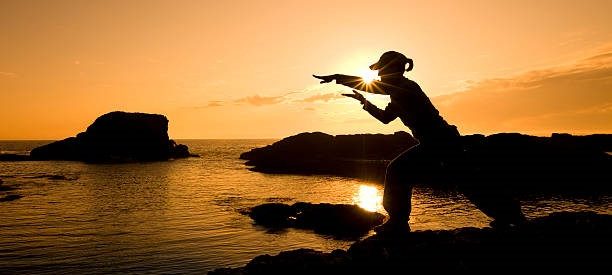
When it comes to your Qigong or Tai Chi practice, bear in mind that summer corresponds to the Fire element and the Heart organ system (which includes the Heart, Small Intestine, Pericardium [Heart Protector], and Triple Warmer). Practice your Tai Chi with strong movements and enhanced breathing. Include some of the more physically demanding Qigong exercises or forms. And take some time in each session to stand, breathe, and tap into the Heart virtues of Joy and Peace.

The Heart energy is a pulsating energy. It wants to beat, expand, and communicate. Utilizing the extra energy you feel during summer to stimulate your heart function is much better than during the winter, when your heart energy is naturally lower. Maintaining appropriate activity levels helps enhance your heart’s function, promotes your body’s metabolism (especially fat metabolism), and can help prevent atherosclerosis.

Bottom line: during summer, train hard and sweat freely!

You Can Do It!

Dr. Karen

The Best Time to Exercise

What’s the “best” time to exercise?

Most fitness and health professionals will say the best time is the time of day that YOU will follow through and exercise. You should choose a time that works for you based on your schedule and energy levels.

Good advice! However, I’d like to make a case for exercising first thing in the morning.

I wasn’t always an early morning exerciser. However, as I got deeper into my Qigong practice, I began to follow the traditional advice to practice Qigong first thing in the morning, preferably as the sun is rising. The air is fresher and cooler, the Yang energy is rising, and you can relax and focus without interruption – which isn’t always the case later in the day.

I then tested this approach with exercise, such as walking first thing in the morning. Lately, I’ve been getting up at 5:45am to join my sensei and other Uechi instructors and students to participate in a virtual morning workout. I alternate days: Uechi workouts three mornings per week, walking the hills in our community three mornings per week. Finish with some Qigong. Head in for a cold shower and get ready for my day.

Central Texas Heat Wave Makes You Adapt

Here in Central Texas our summer came early! In fact, we’re already in the middle of a four or five day HIGH HEAT INDEX event.

We’re experiencing heat indexes of 113 to 115. Sheesh! They are running out of colors for the heat maps. We’re seeing more dark burgundies and purples on the weather maps. Southern California and Arizona are just as bad.

Even though I love the heat and love summer, I wave the white flag once the temps get up over about 92 or so. Walking in the hot Texas sun with temps in the 90s and heat indexes over 100? No thank you!

Many folks retreat inside and do their walking or jogging on a treadmill. I can’t stand walking or running on a treadmill! I used to do it when I had to, for example when I was traveling and wanted to get in a workout at the hotel gym. No, for many of us, it’s outside, fresh air, trees and natural beauty – or bust.

When you exercise first thing, you have to arise earlier than usual to fit in your exercise session and have at least a little time to cool off before you jump in the shower. You typically train in a fasted state, with perhaps a cup of coffee or tea as your only sustenance, so you feel lighter. Your body actually LIKES to move first thing! Although it may not feel that way at first, trust me: once you get through the first several days of moving within minutes of awakening, you will begin to enjoy the feeling.

It may take some effort to sell you on trying this out. So here goes. Following are just some of the wonderful benefits you’ll experience when you work out first thing.

Benefits of Exercising First Thing in the Morning

  • Cortisol levels are highest in the morning. Cortisol is the hormone of fear and stress. Exercising first thing, even just for 20 minutes or so, significantly lowers your cortisol levels.
  • Sweating from a good workout releases BDNF – Brain-Derived Neurotropic Factor – which can enhance your cognitive abilities. BDNF repairs brain cells damaged by stress; accelerates the formation of neural connections; and promotes neurogenesis (growth of new brain cells). So you think better and faster.
  • Intense enough exercise first thing (i.e., break a sweat, get out of breath for at least part of the workout) causes the release of dopamine, the “reward” chemical which helps promote our drive to accomplish tasks, and increases the amount of serotonin, the “feel good” chemical that regulates mood and happiness.
  • Early morning exercise helps to boost norepinephrine which improves your attention and leaves you feeling calmer. In turn, this makes you more productive and focused throughout the day.
  • Working out first thing elevates your metabolism. Working out first thing in a fasted state helps you burn fat for energy. And that metabolism bump continues for hours after.


Perhaps the most important benefit: You win that “First Victory” – following through on a commitment you have made to yourself. This helps fuel other accomplishment and goal achievement throughout your day.

Give it try!

You Can Do It!

Dr. Karen

Plucking Your Strings

When we think about Qigong or Breathwork, we often focus on the internal benefits we derive from the induction of vital energy, or qi, caused by the combination of movement, breathing, and focused intention. But there is an additional benefit from doing Qigong or related Dynamic Energy Exercise that we may forget about or not even be aware of.

In Classical Chinese Medicine, we recognize three levels of qi: wei qi, ying qi, and yuan qi. The most superficial of these is our wei qi (pronounced “way chee”), or “guardian qi”, which helps protect us from external pathogens. Wei qi includes not only our immune system, but also our mental and emotional resilience.

You see, “pathogens” or “pathogenic factors” refer to things like bacteria and viruses (a lot of people get a cold in winter), infectious agents or situations (remember COVID anyone?), and even dramatic changes in the weather which can impact folks in any season. They also refer to negative emotional content stemming from uncomfortable or stressful environments or situations, and/or from negative people or unpleasant interactions – in other words, psycho-emotional factors that can reduce the robustness of our immune system.

Your wei qi is akin to your armor. Anything you can do to enhance it is important to maintaining your health AND longevity. When you can set up a strong energetic barrier or bubble around you, you feel safer and more confident. Your wei qi is also associated with involuntary, autonomic processes, such as your heart rate, sweating, and even the peristaltic activity within your digestive system. Pretty important stuff!

One of the fundamental Qigong practices I teach is to “build your bubble” using breathing and intention to build the strength of the wei qi. This powerful practice includes two components that I teach in my course, “Breathing & Qigong for Health and Energy“.

The Other Way to Build Wei Qi

We also build wei qi by exercising. The sinew channels, which include muscles, tendons, ligaments, fascia, and skin (and the smooth muscles of the gut), are conduits of wei qi.

However, certain types of exercise are more effective than others at strengthening fascia, tendons, and ligaments.

The Daoist expression “Plucking the Strings” refers to the effective exercising of the sinews, especially through our practice of Qigong.

Over the centuries several Qigong forms, such as the Yi Jin Jing (Muscle-Tendon Changing Classic) and the Ba Duan Jin (Eight Pieces of Brocade), were developed to stretch and strengthen tendons, ligaments, and fascia, along with inducing or enhancing the flow of vital energy within the meridians.

Focusing on the tendons and ligaments is the real secret to building and retaining strength and flexibility, which in turn helps us retain our mobility, balance, and vital capacity.

The challenge is this: Much of the exercise we engage in is targeted at building our muscles – which is important, of course. But most people don’t do enough to build and maintain the strength of their tendons and ligaments. As a result, they become less flexible, things get tight, injuries begin to happen. Or they lose the ability to do simple things as their grip strength deteriorates (grip strength is a key marker of aging or, alternatively, relative youthfulness and longevity).

“Plucking the Strings” also infers a sense of play and enjoyment. Practicing Qigong is a fun, wonderful, fulfilling, and minimal impact way to stretch and strengthen without the potential risk of injury from other exercise modalities.

Don’t Get Out of Tune

When I was a child of about eight, my parents gave me my first real guitar. What an awesome gift! I played that thing every day. At first, I imitated popular songs on the radio and figured out the chords and melodies. Soon after, my parents paid for guitar lessons.

I studied classical guitar for about eight years, until I was 17. And I was good. However, I reached an inflection point. My instructor told me that, to get to the next level, I would have to put in even more time practicing and perform with greater frequency in recitals. At this time in my life, however, I was more interested in the high school sports I was playing, keeping up my grades while taking an aggressive course load, hanging out with friends, and beginning to date.

I just didn’t have that burning desire to become a concert guitarist. I came to the decision that I did not have the time to devote to this level of practice or training. I know my instructor was bummed, but he also understood.

So…I stopped taking lessons. Not only that – I also stopped playing, even for fun.

Once in a great while, I would take my guitar out of its case just to play a little. And every time, it would require extensive tuning because the strings would go slack due to the lack of plucking and strumming.

There are several morals to this sad story, but the key message for you, dear reader, is as follows:

Just as a guitar that is not played will gradually go out of tune…so will your body. AND your immune system. AND your vital capacity. So pluck your own strings on a regular basis!

I’ll have more to say on this in my next blog post. Until then, do your Qigong with a playful spirit. Pluck Those Strings!

You Can Do It!

Dr. Karen

How to Stay Younger Longer

What is the biggest, most major, number one factor in determining
your longevity and quality of life?

According to research over the past 5 to 10 years, it’s your muscle
mass.

Your muscle mass is determined not only by the quantity and quality
of your physical activity. It’s also determined by your metabolism.

More than even your genetics, it’s your metabolism that determines
how quickly you age. Metabolism is the sum total of your body’s
processes of converting food and drink into energy for building up
your body, less the breaking down and getting rid of old cells and
waste products.

The greater your metabolic drive – that is, your body’s ability to
rapidly and efficiently repair and rebuild your tissue – the slower
your body ages.

Building up your body’s anabolic capabilities and building up your
strength – through deep breathing, proper exercise, good nutrition,
and adequate rest – is one of the two major factors you control.

The other factor is mental: staying curious, always learning and
doing new things, and being enthusiastic. In other words, keeping
your inner child awake and alive, rather than buried under adult
pressures and responsibilities.

You – yes, you! – have the power to make profound changes in your
body composition, mental clarity, vitality, and sense of personal
power.

In fact, from studies on identical twins, scientists have learned
that aging is about 35% genetics, and 65% how we live.

I remember a great example of this from one of my biology courses
in college. (I was a Psychology and Biology major, and have always
been fascinated by these subjects.)

The professor was discussing the fact that lifestyle and other
external factors, such as life events, have more influence on our
health and aging than do our genetics.

He held up two pictures of two different women. One looked like she
was old enough to be the other woman’s mother.

We were shocked when the professor told us that both women were
exactly the same age, born in the same month in the same year.

Wow!

As they get older, people tend to allow their level of physical
activity to decline. Or they may avoid activity altogether,
especially if faced with a health challenge.

Then they wonder why they feel so tired, stressed and worn out
all the time, with aching backs and joints. They have forgotten
that our bodies operate under the “move it or lose it” paradigm.

Cultivating energy through dynamic exercises…building and
maintaining muscle mass…and maintaining your range of motion,
particularly through the spine and core, are keys to ensuring
enduring vitality.

Not only will you slow the degenerative processes of aging. You
will also provide yourself with a higher quality of life.

Bottom line: if you haven’t already, begin today to take action to
build yourself up. You have more control than you think in how
well – or poorly – you age. Simple lifestyle choices can make all
the difference.

I’ll have more to share with you on this in coming tips.

You Can Do It!

Karen

“Best Breathing Exercises: Transform Body Mind and Spirit with
Dynamic Energy Exercise!”
www.BestBreathingExercises.com

Copyright, Karen Van Ness, 2011