Waiting for Hurricane Helene

Last Friday, I flew from Austin to Panama City Airport (ECP) to visit my parents and brother. My brother picked my up at the airport and we made the drive from Florida up to the lower southeast corner of Alabama where they live. As we drove, I observed that there is STILL damage visible from Hurricane Michael, a devastating CAT 5 storm that hit the Florida Panhandle back in October 2018. Never expecting that…

…we would be in the path of a hurricane now!

Yes, Hurricane Helene is currently approaching the Florida panhandle, this time drawing a bead on the Big Bend area of the coast. She’s expected to grow to a CAT 4 storm with tremendous, possibly record-setting storm surge along areas of the Florida coast. She’s a “big girl” too – a huge storm whose winds and rains have been hitting our area in Lower Alabama for the past four hours. With more to come.

Our impacts here are yet to be seen, but we’ve been told to expect CAT 1 or CAT 2 hurricane effects. Fortunately, we will be on the west side of the hurricane and not feel the full force about to be endured in Florida and Georgia. Nevertheless, we completed our preparations yesterday. The schools and many businesses are closed today or are closing early. We’re as ready as we can be.

I feel for those folks along the Florida coast, many of whom have endured an increasing number and severity of hurricanes in the past five years. Idalia is the one most cited by folks in the Big Bend area, especially along the barrier islands such as Cedar Key. I hope and pray these folks battened down the hatches as well as they could – and then got the hell out of there!

I understand the desire to stay and ride it out, in order to protect your home or business and be on the ground to begin recovery. We went through the same when my parents first retired and build their dream retirement home along the coast in North Carolina. The decision to stay or evacuate can be an agonizing one. You scrutinize each new update, trying to decipher whether you can ride it out safely OR you better leave. If you wait too long to make that decision, you then get stuck in massive traffic as folks evacuate. Or, worse yet, you are stuck and forced to ride it out.

One more data point: when I was age 9 to 11, we lived in Tallahassee, Florida. One of the key things I remember about living there is the proliferation of beautiful, stately trees. Especially the oaks with the Spanish moss hanging off the branches. Tallahassee will be right in the eye of this storm as it passes through. I fear many trees will be uprooted or damaged.

Anyways, I wish the best possible outcome to the people about to be impacted.

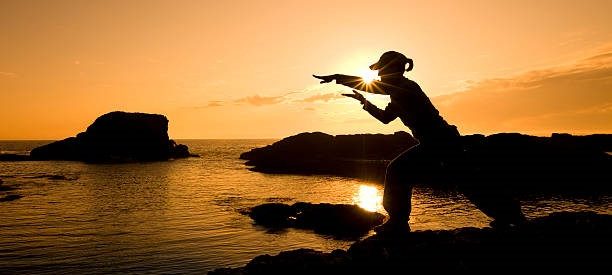
In the meantime, I did a little training out on the back porch. It’s the first time I can remember actually working out during a hurricane.

A little back story: It is said that the founder of Shotokan Karate, Funakoshi Gichin, would stand out on the roof of his house on Okinawa during monsoons (the Pacific ocean version of hurricanes). He would grip a tatami mat with both hands, which acted like a sail, and would strive to hold his horse stance on the roof.

As described by an observer and martial arts colleague:

“Now the young man on the roof assumed a low posture, holding the straw mat aloft against the raging wind. The stance he took was most impressive, for he stood as if astride a horse. Indeed, anyone who knew karate could readily have seen that the youth was taking the horse-riding stance, the most stable of all karate stances, and that he was making use of the howling typhoon to refine his technique and to further strengthen both body and mind. The wind struck the mat and the youth with full force, but he stood his ground and did not flinch.”

OK, I know my performing techniques and forms on my parents’ back porch – BEFORE the hurricane even arrives – is nothing like what Funakoshi did.

However, I can report that, energetically, training in the wind and rain felt different. It felt exhilarating. You can sense the current energy as well as the impending energies to come. I plan on periodically going outside for as long as I can and to breathe, stand, and experience the wind, energy, and power of Mother Nature.

Bless all of those in the path of this storm.

You Can Do It!

Dr. Karen

Resilient Wellness Qigong Featured in New Book

My Uechi-Ryu instructor, Grandmaster George Mattson, known as “The Father of Uechi-Ryu Karate in America”, just published his fifth major book, titled “The Dynamic World of Martial Arts: Unleashing the Power Within”.

I’ve immensely enjoyed reading the book. It’s a mix of Mattson Sensei’s experiences over the years as one of the leading proponents of traditional martial arts in the U.S.; his perspectives on the changes we’ve seen over the decades in how martial arts are viewed, practiced, and taught; and a deeper view into his own training and mindset practices that have helped him achieve such longevity as a martial artist, instructor, and leader.

Mattson Sensei asked me and a few other instructors to provide some sections for the book. I was honored to be asked AND I’m thrilled that Resilient Wellness Qigong is featured in its own small chapter within the book.

Why Uechi?

I first trained in Uechi Ryu Karate back in the early 1990s. (Yes, I am dating myself). I was already a Second Degree Black Belt in a traditional style of Tae Kwon Do and was interested in studying a martial art that would be a good complement to the medium to long range strategies of my primary art. Uechi is an infighting style with roots in Southern China. It’s also a “fighting style” with a focus on developing actual fighting skills and reactions with many open hand techniques, low kicks, and simplified stances and footwork.

My first Uechi instructor was Sensei John Carria who is one of the leaders within the Uechi community. John was (and is) an excellent instructor and continues to learn, develop, and share those learnings through teaching and his own book that came out last year. (Click the book cover to the right for a link to John’s book.)

When I first started learning Uechi, I truly felt like a fish out of water. It was so different from what I was used to. But it also intrigued me. I trained hard and eventually earned a First Degree Black Belt under Carria Sensei’s instruction. I knew I still had a lot to learn and sensed a depth to the art that would take some years to fully understand and appreciate. And it has not disappointed.

When I became a mom, I took some years off from formal training. I would train on my own and hit the bags, and sometimes work out with my son. But it was years before I got the bug to train formally again as a student. As I searched for and considered options for training, I happened upon Mattson Sensei’s virtual dojo, AtHomeKarate.com. I saw that he had pioneered virtual instruction years prior, long before advancements in remote communications technology via the internet made virtual communications easy and inexpensive. Through his early experimentation, George developed a highly effective approach for teaching and coaching long-distance, helping students and black belts from all over the world either commence their martial arts study, OR continue their Uechi-Ryu development.

“Call Me George”

One of the things I love most about Mattson Sensei is how down-to-earth he is. The first time we spoke on a coaching call, I addressed him as Sensei. He immediately said, “Call me George”. He has no need for the “Grand Poobah”, “Super Mega Grandmaster” titles that seem to have proliferated in the martial arts. Given his stature within the Uechi world, and martial arts world in general, this was so refreshing – and a testament to the quiet confidence he enjoys after many decades of contribution.

He is also super supportive and uplifting. I came back to Uechi as an out-of-shape mom and businesswoman who wanted to train in a meaningful way but did not have a good dojo or training opportunity close by. Would I be able to train martial arts again without injuring myself or looking like an idiot? George assuaged my concerns. His approach is to get going and start training and, as he says, “Train Smart. Train Often”. His key lesson is consistency. Do something every day, even if it’s just your three Sanchins and some pushups. And build from there.

I also appreciate that George calls you on your bullshit. He lets me know if he thinks I have not trained as hard as I should have or progressed on something like I should have. We all respond better to someone providing clarity and honesty in their feedback, because we want to know where we stand and how we are doing.

And George models everything he pushes his students and instructors to do. He’s 86 years young, still trains every day, still loves to teach, and continued to inspire and empower so many of us through his instruction and example.

Anyways, I highly recommend the book for any and all martial artists. And if you’ve never trained, I still recommend it. Who knows: the stories, advice, and perspectives George provides through the book may inspire you to learn more or even begin training.

(And be sure to check out the Qigong chapter starting on page 41!)