
The Case For Mindfulness

I was driving around yesterday, running some errands. I realized
at one point that I had totally zoned out.

You know how it is when you are in the car, perhaps listening to
some good music, and you get completely tranced out.

Before you know it, you are five miles down the road and don’t
remember one bit about your trip.

This was brought to my attention by none other than my son, Miguel.

He notices everything. He often sees something that I have not
attended to, then asks me questions about it. of course, this
compels me to respond and pay better attention.

The adult is tranced out, while the child is totally excited and
immersed in the world around him.

Hmmmm….I think Miguel is trying to teach me something.

Not that it’s wrong to daydream or lose yourself in your thoughts.
Quite often, you are working out problems and coming up with
solutions to challenges during these ruminative periods.

But there’s a lot to be said for mindfulness as well.

For example, I believe that the more focus and concentration you
put into your workout – whether it’s breathing exercises, or
cardio, or lifting weights, or yoga – the better the results you
will achieve.

If, as you exercise, you think about the beautiful physique you
are sculpting, or the high levels of energy and health you are
developing, or your increased ability to handle challenges and
manage stress…well, not only will you enjoy your workout more.
You will also create a positive energy that will stay with you
after your workout.

And you will truly feel your body as you put it through its paces.
This body awareness, this sense of self, is very empowering.

One of the reasons I admire the Japanese is because they practice
mindfulness as part of their daily lives.

Let’s take something as simple as a cup of tea.

Here’s my method: boil the water as I do something else. Let the
tea steep for five minutes as I do something else. Drink the tea
as I read or work or watch TV. Finish it within five minutes
and move on to something else.

Contrast this with the traditional Japanese tea ceremony.

Everything is choreographed down to the smallest detail. The host
and the guest each have a role. Nothing is hurried.

The participants enjoy the delicious tea. And they benefit from
this wonderfully tranquil and uplifting respite from their hectic
lives.

See if you can create these wonderful moments of total attention
and mindfulness for yourself. Totally focus on the activity of
your choice – whether it’s drinking a cup of tea, or reading a
good book, or exercising.

I think you’ll find these moments will add to your appreciation
for, and enjoyment of, life.

You Can Do It!

Karen

“Best Breathing Exercises: Transform Body Mind and Spirit with
Dynamic Energy Exercise!”
www.BestBreathingExercises.com

P.S. Would you like to improve your energy levels…better
manage and even transform stress…or “finally” lose the weight
you’ve been trying to take off?

Your best strategy is to begin by getting centered and focused
with the power of deep breathing. The Best Breathing Exercises
programs can help you do just that. For more information on the
program that could be just right for you, visit
http://www.BestBreathingExercises.com.

Copyright, Karen Van Ness, 2011
Psychology Over Mechanics

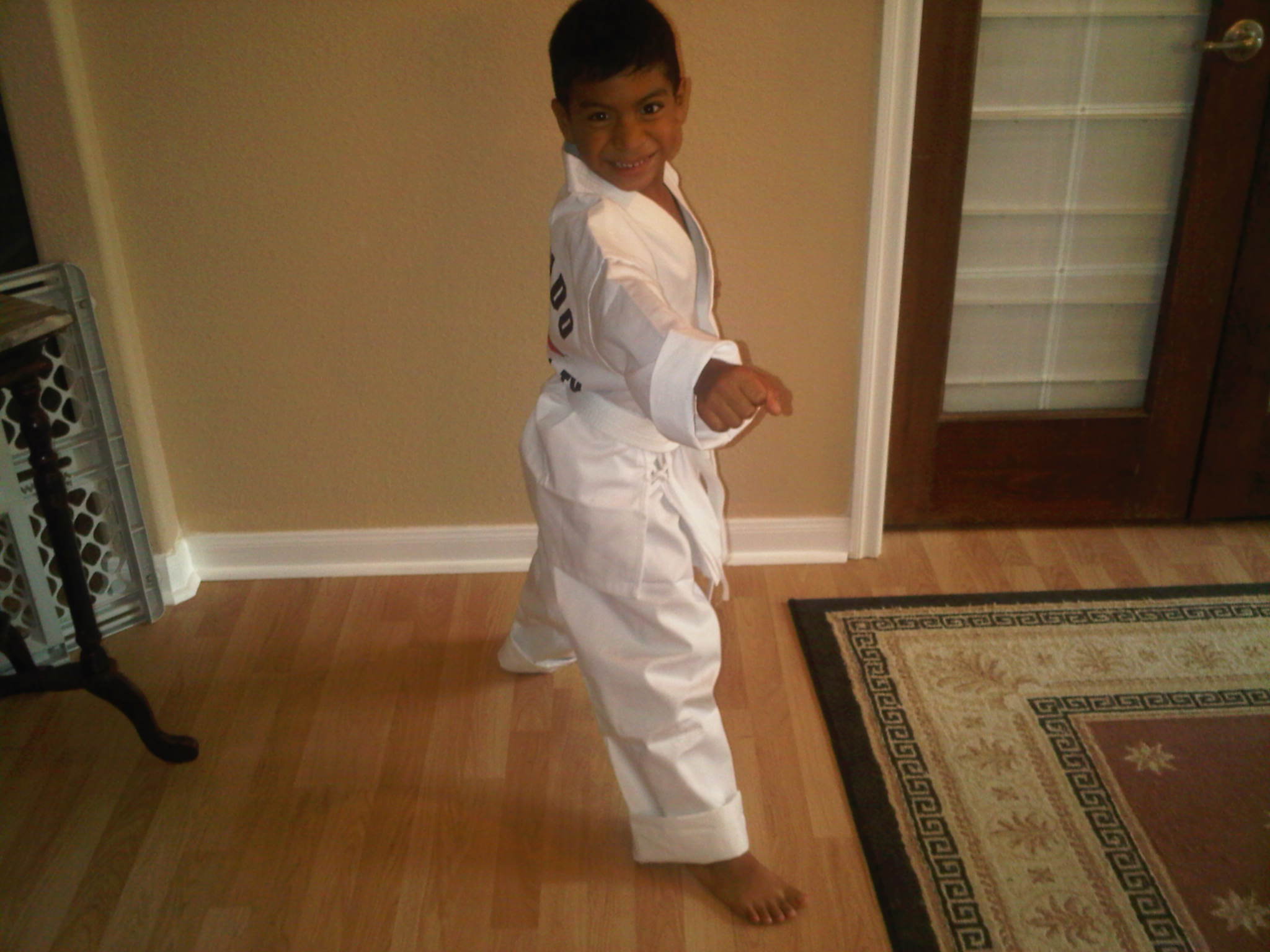
Recently we enrolled our son Miguel, who just turned 7, in
tae kwon do classes.

He’s excited and enthusiastic. And I’m quite proud, since one of
my life-long loves and passions has been martial arts. A chip off
the old block, as they say!

Miguel in his fighting stance, ready for action. How's that for enthusiasm?

One of the most important lessons we are seeking to teach Miguel,
with his TKD lessons as well as with his other activities, such
as soccer, is the importance of showing up.

You’ve heard that saying, “Ninety percent of success in life is
just showing up”.

It’s attributed to Woody Allen, and I believe he actually said
50 percent. People grabbed hold of the thought and embellished
a little.

But he has a great point. It’s true that, very often, we avoid,
dismiss, or shy away from the meetings, classes, events and so
forth that could really make a difference in our lives.

Could be that we think we are too busy. Or we are intimidated or
afraid. Or we are not ready or willing to make the commitment
required.

I know the feeling well. There have been plenty of times over the
years when I didn’t feel like participating in a meeting. I knew
it would be boring, would go on for too long, and might not
achieve any sort of resolution.

But I went anyways, because I knew I might have one piece of
information that could move things forward, or get others thinking.
Or I could add moral support to someone else’s position. Or I
might make a new contact that would prove to be beneficial.

Same thing happens when it comes to your efforts to improve your
fitness or health, lose weight, or better manage the stress in your
life.

You may avoid doing anything because you are afraid of “showing up”.

You are not yet ready to make the commitment to follow through –
to be an active participant and put forth your best effort into
getting better.

Well, when you find yourself hiding or retreating from the
meetings, the classes, the workouts…or from getting the
information and programs you need…or from making the lifestyle
changes that could really move you forward….think about what
Woody had to say.

Just show up. Attend that meeting or class. Do that workout. Order
that book or program. Make a few simple changes to your diet.

Don’t put excess pressure on yourself. And don’t expect perfection.

Guess what: you don’t have to be perfect. In fact, you don’t even
have to be that good to begin reaping the benefits.

For example, Miguel isn’t that good yet. Although he and I have
“trained” together and I’ve shown him some basic stuff, in truth
he is just startigng out. He has a lot to learn.

BUT — he’s enthusiastic. If he shows up regularly for classes,
if he focuses and participates during class, and if he practices
a little each day outside of class…the sky’s the limit!

The truth is, all achievement, all self-development rests on a
very basic principle: “Psychology is 80 percent, mechanics is
20 percent.”

The mindset and attitude that you bring into the endeavour is far
more crucial to its outcome than the specific skills or knowledge
you bring.

Holding positive expectancy firmly in place can help accelerate
your efforts, especially when it comes to the major challenges
that so many of us face, like improving our breathing, losing
weight, better managing our busy lives, or regaining that vital
energy we used to have.

I’ve seen it time and again when working directly with clients
and students.

The ones who are positive and excited get the best results. They
improve their breathing. They reduce their levels of stress. They
lose weight (or gain weight if that is their goal). They feel
energetic and alive again. They begin achieving major goals in
other important areas of their lives.

AND — they enjoy the process.

The ones who are negative or feel like they are being imposed
upon do not get as good results – even if they are already in
better shape to begin with.

And they are the ones I very quickly cut loose. I have better
things to do, and other people to help.

I’ll leave you with some words of wisdom by Norman Cousins, from
“Head First: The Biology of Hope” (1989):

“Hope, purpose, and determination are not merely mental states.
They have electrochemical connections that play a large part in
the workings of the immune system and, indeed, in the entire
economy of the total human organism….

“The modern physician, therefore, will prescribe not just out of
the pharmacy or his little black bag, but out of the magnificent
apothecary that is the human brain, which can activate and
potentiate the healing system.

“The rosters of emotion are hope, faith, love, will to live,
festivity, playfulness, purpose, and determination. These are
powerful biochemical prescriptions.”

You Can Do It!

Karen

“Best Breathing Exercises: Transform Body Mind and Spirit with
Dynamic Energy Exercise!”
www.BestBreathingExercises.com

Copyright, Karen Van Ness, 2011

Harness The Force of Frustration

When it comes to your fitness and health, you’d probably say that
they are important to you.

Yet how committed and consistent are you at taking action in these
two areas, each and every day?

It takes a lot to make significant changes in your lifestyle, your
schedule, and your attitude and outlook…changes that will propel
you towards greater things in your life.

It’s a lot more comfortable to stay where you are, with what you
know, and dream about “If only…”

If only I were thinner. If only I could put on more muscle. If only
I could get control of this stress and anxiety and live in a more
relaxed manner. And so forth…

Seeing the need to change, thinking you ought to change, even
wanting to change are all good. But they don’t quite get it done
when it comes to actually taking the consistent, sustained action
that will enable you to reach your goals.

No, it takes something much stronger. And that something
is…frustration.

Yes, that negative, nasty emotion. But it’s true, something very
negative can help you make positive changes.

I used to abhor frustration. I hated the feeling. I think frustration
and boredom are the two states I seek to avoid the most.

However, I’ve realized from my own experiences, as well as working
with others, that you’re not really ready to do the things and think
the thoughts you need to until you are at the end of your rope, and
ready and willing to do what it takes to get out of the situation
you are in.

If, for example, you get to the point that you are really
frustrated with your anxiety and levels of stress, and you don’t
feel like you are improving or getting a handle in this area…or
you are frustrated with your appearance and inability to lose the
weight you want to lose….then celebrate.

Get happy! Put your hands in the air and shout “Hur-rah!”

I’m serious. Because when you get truly frustrated, you are ready
for a breakthrough.

You are at the point where you begin to ask yourself the right
questions and look for the information or resources that can help
you.

So leverage the frustration you may be feeling and use it to
energize and support your efforts to change or improve.

Here’s one more thought on frustration: it can also trip you up.

Once you are on the path to losing weight, or gaining the upper
hand on stress, or improving your energy levels and sense of
control, you may at times experience little or no progress.

You may get frustrated at how slowly things are changing. Or you
may get frustrated at yourself for slipping up or backsliding.
You may think you’ll never reach your goals.

Well, once again, use this frustration as a tool to energize
yourself.

Don’t let it put you into a funk, or get so down that you give up.

Here’s a great quote I heard a long time ago, that helps describe
this point:

“How long would you give the average baby to learn how to walk
before you didn’t let him or her try anymore?”

That’s a crazy question, isn’t it? You’ll give your kid as long
as it takes, and all the love and support to help them, until
he or she learns how to walk.

And think how frustrated babies and toddlers can be at times,
when they are trying to master a new motor skill. But they keep
at it, again and again and again, until they finally get it.

Why not apply this same approach to yourself?

You are a goal-seeking mechanism. Your natural state is to
succeed.

However, your natural state is also inertia. Kinda like a “good
guy/gal – bad guy/gal” thing. This is the duality of our nature
as human beings.

Therefore, you have to get creative sometimes and use the power
of a strong emotion, such as frustration, to get you off your
you-know-what and into taking action each day toward your goals.

You Can Do It!

Karen

“Best Breathing Exercises: Transform Body Mind and Spirit with
Dynamic Energy Exercise!”
http://www.bestbreathingexercises.com/

P.S

. I’d love to help as you leverage your frustration into
action with information and inspiration that can help you take
smarter steps towards your energy, fitness and life goals. Visit the
Best Breathing Exercises website for more on the products
and programs that can help you transform your health.

Copyright, Karen Van Ness, 2011

Prevention Versus Problems

They say that it’s difficult, if not impossible, to “sell”
prevention to people.

We don’t respond to appeals based on preventing disease or health
problems, because we think they won’t happen to us….OR the
possibility seems so far off in the future, we just can’t get too
worked up about it.

But when the you-know-what hits the fan, and you are faced with a
health crisis – boy, does that get your attention.

You’ve probably faced a health crisis of your own. Perhaps it was
becoming overweight. Or being diagnosed as pre-diabetic or diabetic.
Or finding out you have high blood pressure.

It could be anxiety, which everyone experiences from time to time,
which suddenly becomes overwhelming and limits your ability to
function.

When you reached this point, chances are you were in disbelief.
Especially if you had experienced no major health problems prior
to the diagnosis.

I remember how incredulous I was when I was first diagnosed with
asthma. And I hear this from many people who write in. They can’t
believe it when they find out they have a chronic disease such as
asthma, or high blood pressure, or diabetes.

One typical reaction is to go into denial, at least to a certain
extent. Many people diagnosed with very treatable illnesses or
health problems don’t take them seriously, so they may not take
their medications or follow recommendations on lifestyle changes.

Doctors complain quite a lot about compliance – or more accurately,
non-compliance  – with the medical and lifestyle regimens which
they recommend to their patients.

Hence the issue with prevention.

We often know what we should and could be doing. But we remain in
a state of denial. We have trouble visualizing what the long-term
outcomes could be for us if we don’t get in gear and make changes.
So we push off to tomorrow what we could be doing for ourselves
today.

Well, I know better than to fight against the current. The
programs available through the Best Breathing Exercises web site
are designed to help you improve your breathing, your fitness and
your health, as well as help you bust through any limitations that
current conditions or challenges may be placing on your life.
(Visit www.bestbreathingexercises.com to learn more.)

But – and perhaps I shouldn’t say this,’cuz I’ll blow the secret –
everything in my programs is also congruent with the most effective
and proven habits and practices that can help you achieve more
robust health and avoid or prevent illness and disease.

Whether you want to lose weight, or are looking for relief from
stress, high blood pressure, chronic pain, or anxiety….What I
teach and share with you will help you in your efforts to
transform your health and enjoy a more fulfilling life. It can
even help you age more gracefully.

Here’s a remarkable fact: researchers have determined that less
than one third of the loss of physical function and mental acuity
as we age is due to heredity, or our genes. More than two thirds
is due to lifestyle habits.

Habits such as regular physical activity, eating well, watching
your weight, getting enough sleep, and not smoking, can help you
live longer – AND have more vim and vigor throughout your time on
the planet.

You Can Do It!

Karen

“Best Breathing Exercises: Transform Body Mind and Spirit with
Dynamic Energy Exercise!”
http://www.bestbreathingexercises.com/

Copyright, Karen Van Ness, 2011

The First Step To Transforming Stress Is Awareness

My family and I were on vacation and I decided to completely get
away from everything for about 10 days.

We stayed at beautiful SeaGrove Beach, on the Florida panhandle.
Part of the “Redneck Riviera” as some call it. I call it heaven.

Truly, the beaches are amongst the most beautiful I have ever
seen…and I have traveled to a lot of beaches all over the world.
And this section of coast is not as built up as others further
down. It’s more family oriented and provides a slower pace.

This made it the perfect vacation for disconnecting from the grid.

We didn’t watch TV. Well, except for Game 7 of the Stanley Cup
finals, when our second favorite team, the Boston Bruins (remember
my Caps are number one in my heart) won the Stanley Cup!

I didn’t do emails. I turned off the Crackberry. I didn’t even wear
my watch.

I had made a promise to myself NOT to have a schedule, NOT to have
to be anywhere at any particular time, and NOT to worry about what
time it was. And I pretty much stuck to my promise.

When you are on the beach for a good portion of each day, this is
easy to do.

It’s also easy to simply relax and enjoy yourself. Like most kids,
our son loves the beach. Playing and boogie-boarding with him
was a timeless experience. Five hours sunbathing, reading and
playing on the beach, or boogie-boarding or swimming in the
refreshing water, would fly by.

That’s the astonishing power of being in the moment.

Kids have so much to teach us adults. One of their lessons: they exist totally in
the moment. They don’t worry about what happened an hour ago.
They aren’t worried or anxious about what might happen tomorrow.

They just…live!

When I am working, I am constantly aware of the clock. I have
an idea of what I wish to accomplish in a day, and I try to
script my day and stay on target so I complete all, or most of,
my objectives and to-do’s.

Our vacation provided an excellent touchpoint for me. It
promoted being in the moment. It encouraged me to remain
oblivious of the time.

I had that same state of timelessness and living in the now
that kids enjoy. And boy was it fun!

Each of us was that way at one point in our early lives. But
something happened.

As we grew up and became adults, we began to feel the stresses of
modern life.

Some stress is good. It tests us and helps us grow. But chronic
stress is not so good. It can lead to very serious physical and
emotional health problems.

In fact, stress-related illnesses are among the fastest growing
conditions.

Our modern lifestyles, with all the mechanical and technological
devices meant to make us more efficient and improve our lives,
have actually sped up our lives.

Seems like there’s always more to do, one more item to add to the
pile.

We’re constantly reacting to a barrage of phone calls, emails,
bad traffic, tight schedules, and ever increasing demands for
performance – at work and at home.

For many people, stress becomes such a natural state that they
become used to operating in a state of high arousal.

They become so addicted to the mood and energy surges and swings
associated with stress, they can’t imagine life being any other
way. And when they have a rare moment of peace and quiet…they
get antsy. They don’t know what to do with themselves.

Do you feel like this describes you, at least in part? Has stress
become almost like a drug to you?

One way to know for sure is to become more aware of how you act
and react to the pressures and time constraints of your daily
life.

Here are some examples of behaviors to consider:

-Do you regularly add more tasks or responsibilities to an already
full schedule – even though there are other people who could do
it?

-Do you typically wait until the last minute to complete a project,
because you “work better under pressure”.

-Do you sometimes or often talk to yourself in negative or
disparaging terms? In other words, is your “self-talk” often
negative and de-motivating? Does it take the wind out of your
sails, or add to the stress you feel?

-Is your breathing often tight and partial? Do you get tension
headaches, tired or sore neck and shoulder muscles, or back pain
on a regular basis?

-Do you tell yourself you can “do it all” – even though
subconsciously you feel like you are just about to blow?

-Do you medicate yourself with food, drink, or compulsive
behaviors?

Many people go through all of these behaviors – every single day.

If you’re honest with yourself, you’ll probably respond
affirmatively to at least one or more of these examples.

That’s good! No really, it is.

Because the first step to doing something about chronic stress
is to become aware of it.

In my next post, I’ll discuss the next productive step you can
take to begin to master stress and regain control.

You Can Do It!

Karen Van Ness

“Best Breathing Exercises: Transform Body Mind and Spirit with
Dynamic Energy Exercise!”
http://www.bestbreathingexercises.com/

P.S. If you’d like to reduce and release stress, tension and
fatigue within minutes, I highly recommend the Secret Power of
Dynamic Energy Exercise Course, Volume I: Invigorate & Rejuvenate
.
This special combination of breathing and movement helps dissolve
stress and tension, effortlessly release tight muscles and joints,
and leave you feeling calm, relaxed and mentally alert.

For more information, or to order your own copy, click here.

Copyright, Karen Van Ness, 2011

Improve Your Energy with Proper Posture

Correct, upright posture is essential to maximizing your energy.

The spine is the major conductor of nerve messages.  Its health is
critical to the proper functioning of the organs. That’s why I
included exercises that help relax and lengthen the spine and
supporting musculature in the Secret Power of Dynamic Energy Exercise
Course, Volume 1; Invigorate and Rejuvenate.

A straight, elongated spine supported by strong, limber
musculature is critical to boosting your energy levels.

Most people have the opposite: a weak, compressed spine surrounded
by chronically tight, even painful, muscles. In fact, it’s been
reported that 80 percent of us will suffer from lower back pain at
some point in our lives.

One of the easiest and simplest ways to improve your posture is to
visualize that your sternum (breastbone) is on a string that is
hanging straight down from the ceiling.

Look and feel how you are sitting or standing right now. Are you a
little slouched or hunched?  Are your shoulders rolled forward? Is
your head inclined forward?

Now imagine that a string is attached to your sternum and an
invisible someone hidden in the ceiling is pulling the string
straight up.  What happens?  If you do this correctly, your
sternum lifts, your chest sticks out a bit, your shoulders
naturally rotate back, and your back straightens.

You should be vigilant about your posture, whether sitting or
standing. It’s so easy to slump or hunch, especially when you are
tired.

I particularly have to watch myself when I am clacking away on the
computre. I have trained myself to periodically check and adjust
my posture.

On the days when I don’t do this, I find that my shoulders, neck
and back are stiff.

We were watching the Eastern Conference hockey playoffs last
night between the Bruins and the Lightning. (Since my Caps are
out of things, I am rooting for the Bruins.)

Every game in the playoffs is hard-fought and action-packed.
Hockey players are among the best conditioned athletes. However,
toward the end of games, you will see some of them hunched over,
sticks on knees, as they gasp for breath.

You see this in other sports as well. Basektball comes to mind.
Toward the end of the game, as they become more fatigued, many
players will bend forward and put their hands on their knees
during any break in the action.

I did this same thing plenty of times when I played hoops.

Ironically, when you hunch over like this, it’s not really
helping you supply extra air into your lungs.

You’ll do much better if you bend forward from the hips, so your
back is straight, and push up from your arms to elongate your
spine. Then you can breathe more deeply into your lower back.

In fact, this is a great exercise to do if you have lower back
pain or tightness. Breathe into the area of pain or tightness
and feel it slowly, gradually relaxing with each breathing
cycle.

Back to the posture thing: I never really thought about it until
I had a martial arts instructor who wouldn’t let us hunch over
and touch our knees.

He was traditional in his approach – to say the least – and could
sometimes be hard core. He basically said that we should train as
we would fight.

Would we stop in the middle of a fight and hunch over, panting,
showing our opponent that we were exhausted?

Of course not! We would stand up straight, chest out, and act
like we were just getting started.

And you know what? Not assuming a posture of fatigue, but
holding onto a posture of energy – actually works!

I discovered first hand that your posture can directly influence
your energy levels. From that time ’til today, whenever I am
training hard and getting tired, I stand up straight, walk around
a bit, perhaps swing my arms or do neck circles to loosen up my
traps and shoulders.

I try to avoid putting my hands on my knees and doing the
hunch over, gasping for breath kind of thing.

Try this for yourself. Next time you are getting really winded or
tired when exercising, or engaging in robust physical activity,
stand up straight and slowly, gradually bring your breath under
control.

You can use this “posture approach” in your daily activities.

For example, if you are getting fatigued toward the end of the
day, or you just carried in some bags of groceries (up stairs
no less) and are winded.

Because your posture is good, you will able to breathe more
deeply and replenish the oxygen you need. More subjectively,
you’ll feel stronger. You can recover and continue your day with
renewed energy and focus.

You Can Do It!

Karen

“Best Breathing Exercises: Transform Body Mind and Spirit with
Dynamic Energy Exercise!”
http://www.bestbreathingexercises.com/

Copyright, Karen Van Ness, 2011

Imagine Going Through Life This Relaxed and Focused

Many people are unaware of how much their poor breathing patterns
can negatively influence their lives and their health.

Poor breathing can contribute to a host of problems, including high
blood pressure, asthma, emphysema, anxiety and panic attacks,
depression, weight gain, and even heart disease.

If you have been treated (or are being treated) for any of the
above conditions, you probably did not hear much about breathing,
or receive instruction on how to breathe, from your doctor.

In my own case, including overcoming a moderate to severe case of
asthma — as well as for other people I have worked with or spoken
to — the addition of healthy breathing practice actually
accelerates the results of conventional treatment programs and
medicines.

And it can help you reduce the dosage of, or even eliminate, your
medications – which is very important, given the sometimes serious
side effects of many modern medicines.
 
To incorporate better breathing into your own life, keep in mind
that it’s not just about taking a few deep breaths once in awhile.

Yes, breathing more deeply than you typically do now is very
beneficial. But taking in huge gulps of air, straining to fill
your abdomen and hold the air in, and pushing the air out with
force is not the best way to begin.

There are breathing exercises and techniques that do involve
tension, holding and contracting. But you don’t need to jump to
these right away. First, lay the foundation for good breathing
“hygiene” and control.

The easiest way to do this is to simply breathe through your nose.

You probably breathe through your mouth a lot more than you are
aware of. Keeping your mouth closed and inhaling and exhaling
through your nose is a guaranteed way to calm yourself down,
reduce stress levels, and become more centered.

As you breathe, attend to your posture, as well. Sit or stand up
straight – again, without straining or trying too hard. Here’s
a simple image to help you: imagine that your sternum (breastbone)
is connected to a silver thread hung from the ceiling.

As the thread lifts up your breastbone, you will automatically
straighten your posture. Your shoulders will naturally roll back
and your lower back will naturally move forward for better support.

Breathing through your nose, and standing or sitting up straight,
automatically help you breathe more deeply, without straining or
trying.

Try this: stop what you are doing at various times during the day,
and assess how you have been breathing. Do a little self-inventory
to determine whether you feel a little off or unbalanced in your
breathing as you rush about from meeting to appointment, or try
to get your work completed by some deadline.

Then see how breathing in and out through your nose, with nice
gentle breaths, helps you re-center and re-focus. Try it right
now, as you are reading this.

That’s much better now, isn’t it?

Imagine going through life feeling this relaxed and focused,
most of the time. It’s possible. All it takes is a little of your
time to learn and practice. If you’re interested in incorporating
healthy breathing into your life, you’re in the right place.

In addition to these tips, you can discover exactly what you need
to begin transforming the way you go through life with the programs,
articles and other resources at the Best Breathing Exercises
website.

You Can Do It!

Karen

“Best Breathing Exercises: Transform Body Mind and Spirit with
Dynamic Energy Exercise!”
www.BestBreathingExercises.com
Copyright, Karen Van Ness, 2011

Powerlessness versus Control – Which Do You Prefer?

Each of us feels powerless at one time or the other.

And that powerlessness can cause frustration and even anger to
well up inside of us. Unless you find an outlet, those negative
emotions can gnaw away at your mental and physical health.

The feeling of powerlessness — of not being in control of the
things that directly impact your life — has been shown to be a
major cause of depression. Many studies have linked illness,
weakened immune response, anxiety, and even premature aging to
the frustration and anger that lack of control can cause.

But wait a minute. Do you really lack control?

Yes, there may be people or events you can not fully control.
Your boss may be a bigtime jerk. Events occur, usually at the
worst possible time. Your schedule may be so packed with work and
personal responsibilities that you never feel like you have a
single minute to yourself.

But you definitely have control over one thing, which happens to
be the most important thing.

You control your response to everything going on in your life.

And focusing on your response, making it more constructive, is
an immediate and effective way to assert control and chip away
at those feelings of powerlessness.

One of the best ways to establish control, and respond more
calmly and constructively to the challenges of life, is through
your breathing.

Breathing properly can help you calm down, get centered and get
focused.

In fact, it’s so powerful that entire systems of martial arts
have been built around specific types of breathing. Being able
to attack with power, focus and accuracy; and being able to
defend and counter effectively, with minimal expenditure of
movement or energy — require tremendous focus and a calm
spirit.

If something works in the heat of battle, imagine how well it
can help you when you are “fighting fires” in your personal
life.

If you would like an excellent introduction to putting this
power to work for you, then get a copy of the Secret Power of
Dynamic Energy Exercise Course
 . Within minutes, you’ll discover how much better it feels to
be in control, versus feeling out of control and powerless.

You Can Do It!

Karen

“Best Breathing Exercises: Transform Body Mind and Spirit with
Dynamic Energy Exercise!”
www.BestBreathingExercises.com

Copyright, Karen Van Ness, 2011

A Few Ways to Cultivate Positive Energy for Better Performance

The impact of positive energy on performance in remarkable.

Researchers at Berkeley have found that positive experience alters
brain size, IQ, and learning ability. Children of average
abilities, but high self-esteem, often perform better in school
than more intelligent kids with low self-esteem.

Positive energy can affect your physical performance as well.

Researchers have measured differences in strength and endurance
between subjects who tested higher for positive energy and
optimism.

But how do you cultivate and increase your own levels of positive
energy?

Many people think that positive thinking is the key. If you are
a “glass is half full” (rather than half-empty) type of person,
you are thought to be a more positive and optimistic person.

I think this simplifies things a bit too much. Overall, I’m an
optimistic person…but I have my moments of doubt and negativity
once in awhile too. And I know a few people who see the negative
in just about everything…but surprise me with their refreshingly
upbeat responses whenever a crisis hits.

At any rate, the description I like best is attributed to Winston
Churchill, who said, “A pessimist sees the difficulty in every
opportunity. An optimist sees the opportunity in every difficulty.”

You can approach the cultivation of positive energy in different
ways.

For many people, their religious and spiritual beliefs, and
accompanying rituals, help instill optimism and energy.

For others, reading or listening to self-development literature
or CDs, and working on self image and thinking positively the
majority of the time, help  them cultivate more energy.

For others, throwing themselves into a worthwhile cause and
helping others stirs positive feelings and leaves them energized.

But there is a less appreciated way to automatically and naturally
cultivate more positive energy: your breathing.

You see, sometimes the other methods can fail you. Some days
you just don’t feel positive, aren’t able to truly think positive,
and have just about had it with all the crap going on.

If you care about your performance at work, or as a parent,
spouse or friend, you want to get out of this negative state
as quickly as possible. (Although I have to say, some people
seem to enjoy being in a negative state most of the time.)

When you aren’t positive mentally or emotionally, you can always
get yourself back into a positive energy state with a few minutes
of deep breathing.

If you’re having trouble “seeing the bright side”, and your regular
methods aren’t quite getting you back to a positive energy state, try
some deep breathing.

You Can Do It!

Karen Van Ness

“Best Breathing Exercises: Transform Body Mind and Spirit with
Dynamic Energy Exercise!”
www.BestBreathingExercises.com

Copyright, Karen Van Ness, 2011

Your Second Brain

You have an entire nervous system in your gut.

It’s called the enteric nervous system (ENS). And it’s complex
enough to act independently from the brain.

It literally learns from experience and remembers past actions and
events. It produces a variety of feelings you think of as “gut
feelings” or “gut instincts”.

From an evolutionary standpoint, this second brain developed for
purposes of survival. When rapid thought or action is required, it’s
often better to bypass your conscious, rational brain. Your actions
are faster and, usually, you make a more accurate decision.

Your gut contains 100 million neurotransmitters — the same number
as in your brain. The gut is more responsible than you may have
ever guessed for your mental wellbeing, AND how you feel physically.

The enteric nervous system appears to mirror the central nervous
system. It produces many of the same chemicals that affect your
feelings of energy and wellbeing.

For many years, it was thought that the ENS was part of the
parasympathetic nervous system. In recent years, scientists have
determined that it acts independently.

But the two appear to be interlinked. And one of the ways you can
positively affect the nervous system in your gut is through deep
breathing.

You’ve probably caught yourself sighing when you were frustrated
or feeling down about something. Most people see this as evidence
of depressing feelings.

It’s actually your body’s effort to break out of feelings of
depression or frustration. The sigh involves a deeper inhalation
and exhalation than normal. It involves a physical release through
the breath, that actually enables a release of feelings as well.

In other words, it’s your body’s instinctive effort to help you
feel better.

You can make use of this instinctive mechanism and interplay
between your “second brain” and your parasympathetic nervous
system.

For example, if you are facing a daunting task, whether it’s
delivering bad news, or getting started on a major project that
will involve a lot of work, or perhaps trying to maintain patience
when your kids are misbehaving…

Take a deep breath and then let it release. In through your nose,
out through your mouth, like a sigh. Do this once or twice more.

You will immediately sense a change in how your gut feels. It’s
almost like a release of tension.

If you are experiencing anxiety, or high blood pressure, or pain,
try the same thing. Perform several “synthetic sighs”.

Breathing exercises, like the ones in the Secret Power of Dynamic
Energy Exercise Course, Volume 1: Invigorate and Rejuvenate
,
also help you release and relax.

In just a few moments of coordinate breathing and moving, you
will enjoy a release of tension, tightness and negative
feelings. You’ll able to focus and move forward in a more
relaxed — and effective — manner.

You Can Do It!

Karen Van Ness
www.BestBreathingExercises.com

Copyright, Karen Van Ness, 2011